
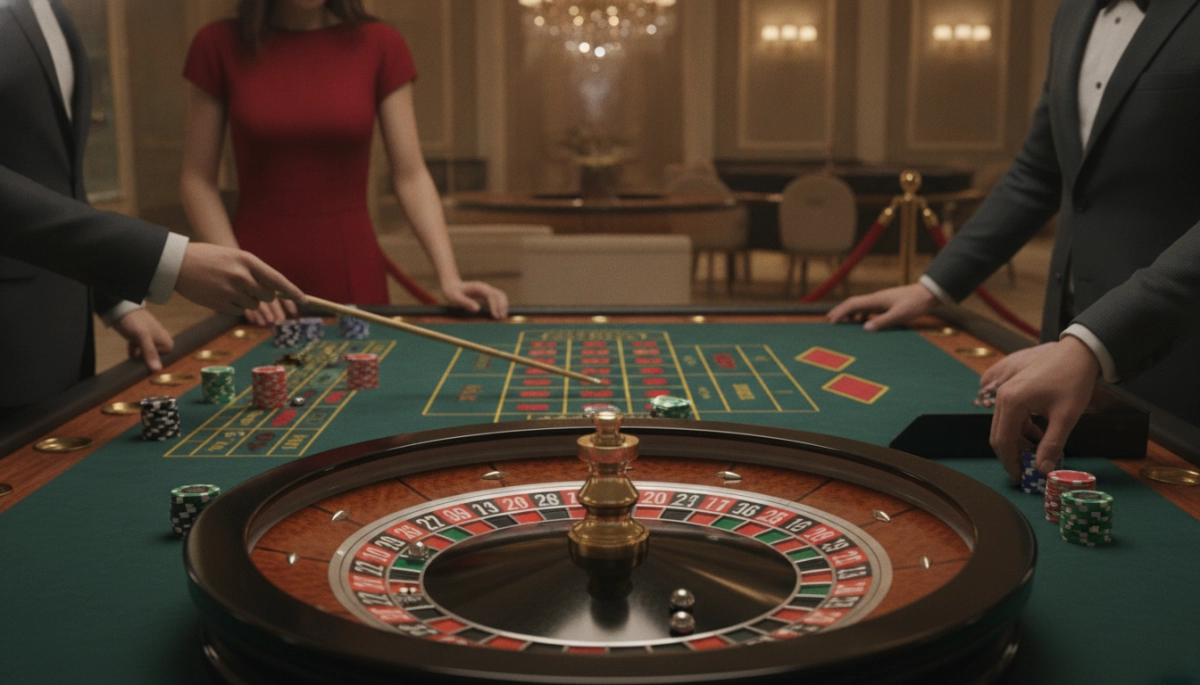
Why Rulet is a simple game you can learn quickly
Rulet is a table game built around a spinning wheel and a small ball. You don’t need complex strategy or advanced skill to participate — the core of the game is choosing which number, color, or group of numbers the ball will land on. Because rounds are fast and outcomes are immediate, rulet remains a favorite at casinos and online sites. This section explains what the game is, the different wheel types, and what happens during a typical round so you can feel confident taking a seat at the table.
What the game looks like and the objective you should keep in mind
Your goal in rulet is straightforward: place a bet on the table before the dealer spins the wheel, then wait to see where the ball lands. If the result matches your bet, you win according to the payout for that bet type. If not, you lose the stake you placed. Understanding the table layout and common bet categories will help you choose wagers with payouts and probabilities that match your risk tolerance.
Different wheels and why they matter to your odds
- European Rulet (single zero) — 37 pockets (0–36). The single zero gives a lower house edge (about 2.7%) compared with American wheels, which improves your long-term chances.
- American Rulet (double zero) — 38 pockets (0, 00, 1–36). The extra double zero increases the house edge (about 5.26%), so payouts are effectively slightly worse for players.
- French variants — same wheel as European but sometimes use special rules (La Partage / En Prison) that can reduce the effective house edge on even-money bets.
How a rulet round unfolds and the basic rules you must follow
Knowing the sequence of a round prevents mistakes at the table and helps you manage timing for placing or changing bets.
Step-by-step round flow
- Players place bets within a time window. Each bet must be placed on the correct area of the cloth — inside for single numbers, outside for groups like red/black.
- The dealer spins the wheel and releases the ball. After a few rotations the dealer announces “no more bets” (or drops a marker) to indicate betting is closed.
- The ball settles in a pocket. The dealer pays winning bets according to the table’s payout schedule and collects losing bets.
- Chips are exchanged or cleared and a new round begins.
Common table terms you’ll use right away
- Inside bets — wagers on specific numbers or small groups (higher payouts, lower probability).
- Outside bets — wagers on larger groups like red/black or odd/even (lower payouts, higher probability).
- House edge — the casino’s long-term advantage; different wheel types affect this number.
With the wheel types, round flow, and basic bet categories understood, you’re ready to learn the full list of bet options, their payouts, and how to place them properly at the table — the next section will cover each bet type in detail and show practical examples you can use immediately.
Inside bets: the high‑payout options and how to place them
Inside bets are where rulet’s biggest single‑spin payouts live — they pay more because they cover fewer pockets. Learning the correct chip placement and typical payouts will let you choose the right mix of risk and reward.
- Straight up (single number) — place a chip directly on any one number (including 0 or 00). Pays 35:1. Example: a $5 straight on 17 returns $180 ($175 win + $5 stake) if 17 hits.
- Split — place a chip on the line between two adjacent numbers (horizontal or vertical). Pays 17:1. Example: a $2 split on 8/11 returns $36 ($34 win + $2 stake) if either hits.
- Street (row) — place the chip at the end of a row to cover three numbers. Pays 11:1. Example: $3 on the 4‑5‑6 street returns $36 ($33 win + $3) if any of those numbers land.
- Corner (square) — place the chip at the corner where four numbers meet. Pays 8:1. Example: $4 on a corner covering 17/18/20/21 returns $36 ($32 win + $4).
- Line (six‑line) — place the chip on the edge between two adjacent rows to cover six numbers. Pays 5:1.
Practical tips: inside bets are ideal if you want occasional large wins with low hit frequency. Mixing one or two inside bets with safer outside bets can add excitement without blowing your bankroll — for example, a small straight combined with a red/black even‑money wager.
Outside bets and even‑money choices for steady play
Outside bets cover larger groups of numbers, giving higher probability of winning while paying less. These are the backbone of conservative or steady play.
- Even‑money bets (Red/Black, Odd/Even, 1–18/19–36) — typically pay 1:1. On European/French wheels you may benefit from La Partage or En Prison rules (see below) that reduce the house edge on these bets.
- Dozens (1st 12, 2nd 12, 3rd 12) — cover 12 numbers, pay 2:1. Good for players wanting a balance of frequency and payout.
- Columns — cover 12 numbers down a vertical layout on the table, also pay 2:1. Chips are placed at the bottom of the column box.
Examples: A $10 bet on the 2nd dozen wins $30 ($20 profit + $10 stake) if a number between 13–24 hits. A $20 red bet returns $40 ($20 profit + $20) when a red number wins.
Simple, practical strategies and bankroll rules that actually matter
No betting system removes the house edge, but sensible approaches help control losses and stretch playtime.
- Bankroll management — set a session budget and a loss limit before you sit down. Divide your bankroll into bet units (e.g., 100 units) and never wager more than a small percentage (1–5%) on a single spin.
- Common systems (understand the risks) — Martingale (double after each loss) can recover losses quickly but is vulnerable to table limits and long loss streaks; Fibonacci and D’Alembert are milder progressions that reduce variance but still can’t beat the house. Flat betting (same stake every spin) is simplest and limits volatility.
- Smart table choice — prefer European or French wheels when available. If you play even‑money bets, use tables offering La Partage or En Prison to lower the effective house edge.
- Mental rules — avoid chasing losses, don’t increase stakes after wins impulsively, and set a realistic win goal so you can walk away with profit.
These sections equip you to place every common bet correctly and to adopt practical money rules. The next part will dive into table etiquette, advanced plays, and how to recognize and avoid common mistakes at the rulet table.
Table etiquette, advanced plays, and common mistakes
Table etiquette
Respectful behavior keeps the game flowing and makes the experience better for everyone. Common courtesies include: wait for the dealer to finish payouts before placing new bets, place chips clearly on the correct part of the layout, avoid touching other players’ chips, and follow the dealer’s instructions when they call “no more bets.” If you’re unsure where to place a bet, ask the dealer before the spin.
Advanced plays and bet types to know
- Announced (call) bets — used in some European and French games; you verbally request specific sectors like “Voisins du Zéro” or “Tiers.” The dealer places the required chips on the racetrack layout.
- Neighborhood/sector betting — uses the racetrack to cover pockets surrounding a winning number; useful for covering wheel sections rather than layout groups.
- Using special rules — on French tables, La Partage and En Prison alter the outcome for even‑money bets on zero and can reduce the effective house edge; learn the table rules before playing.
- Combination betting — mixing inside and outside bets can balance excitement and longevity, but remember combinations don’t change the house edge overall.
Common mistakes to avoid
- Chasing losses with larger bets — progression systems can blow your bankroll quickly and hit table limits.
- Playing the wrong wheel — double‑zero American wheels carry a larger house edge; choose single‑zero European/French when possible.
- Ignoring table limits — know minimums and maximums so your strategy isn’t blocked mid‑session.
- Assuming patterns guarantee results — roulette is a game of independent spins; short sequences don’t predict outcomes.
- Letting alcohol or emotions drive decisions — stay disciplined and stick to your bankroll rules.
Parting advice for your next visit
Rulet is a fast, social game best enjoyed with clear limits and realistic expectations. Practice in free online play or low‑stake tables until you’re comfortable with bet placement and timing. Keep your session budget and goals in mind, prefer single‑zero wheels and tables with favorable rules when possible, and treat each spin as an independent event. For a concise reference to official rules and historical context, see Detailed roulette rules and history.