
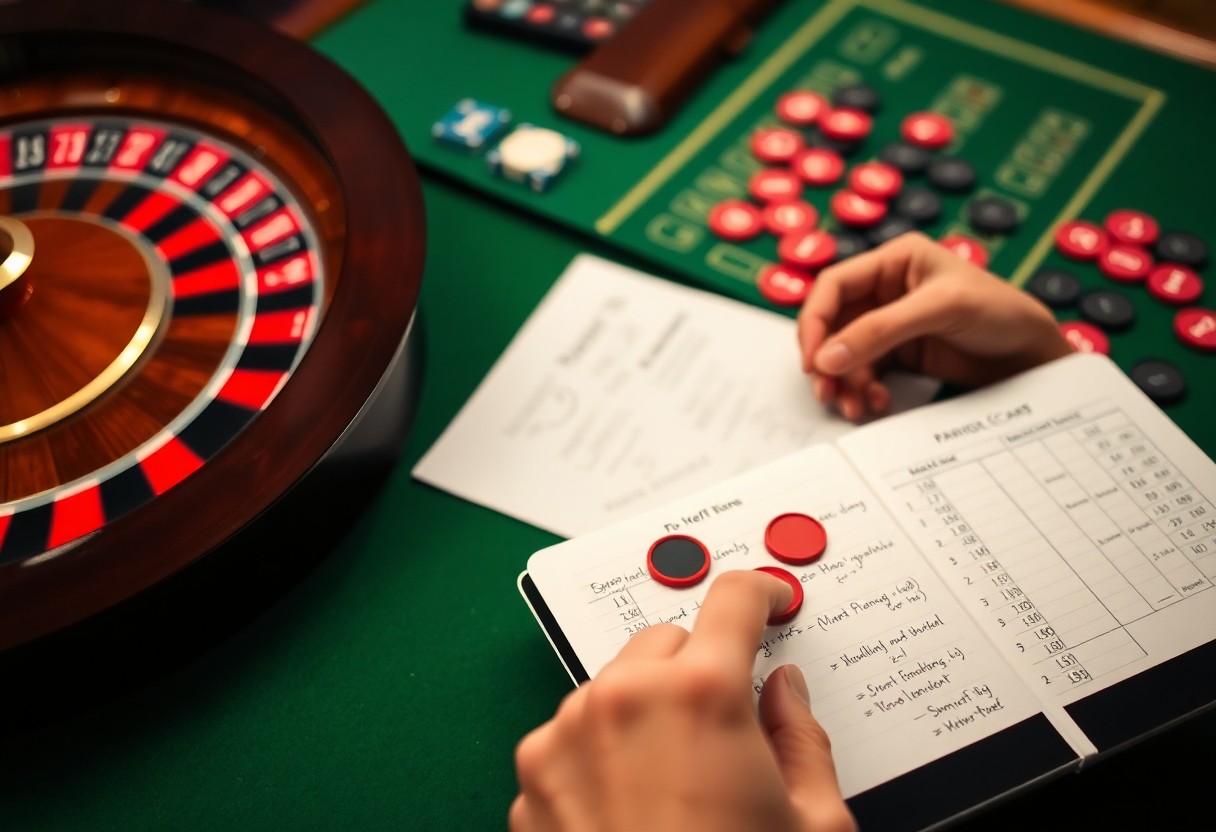
Over the long run, roulette outcomes are governed by probability and expected value, so no system can overcome the house edge on a fair wheel; understanding randomness, variance, and expected value lets players evaluate risk and why patterns are illusory. Responsible strategies focus on bankroll management, bet sizing, and odds awareness rather than chasing wins; treat strategies as tools for decision-making, not guarantees.
Understanding Roulette
Types of Roulette
Different wheels change odds dramatically: European (single 0) and American (0 and 00) are the most common, while French adds rules like La Partage to lower the house edge; casinos also offer mini single-zero wheels and multi-wheel variants for faster action. Bet structures and payouts remain similar, but pocket count and rule tweaks shift expected value. The house edge is 2.70% on European wheels and 5.26% on American wheels.
- European – single zero, lower edge
- American – double zero, higher edge
- French – La Partage reduces losses on evens
- Multi-wheel – multiple spins per bet
- Mini – compact single-zero tables
| European | 37 pockets (0-36); house edge 2.70% |
| American | 38 pockets (0, 00-36); house edge 5.26% |
| French | Single-zero with La Partage or En Prison rules; edge ~1.35% on evens |
| Multi-wheel | Simultaneous spins on several wheels; increases variance, same per-wheel EV |
| Mini | Smaller layout, single-zero; suited for low-stakes play with European odds |
Basic Terminology
Inside bets target specific numbers or small groups (picks like a single number pay 35:1), while outside bets cover larger categories-dozens, columns, red/black-offering roughly even payouts; house edge, expected value, and variance determine long-term outcomes and risk profile. The payout table and pocket count directly set expected returns.
Inside bets (straight, split, street, corner, six-line) carry high payouts but steep variance: a straight bet wins 35 to 1 on a 1-in-37 or 1-in-38 chance, so EV = (35/37)−1 ≈ −2.7% on European wheels; outside bets (odd/even, red/black, dozens) lower variance but still inherit the house edge. Use the house-edge numbers-2.70% for single-zero, 5.26% for double-zero-and the rule variants like La Partage to calculate expected loss per spin (stake × edge).
Mathematics of Roulette
Numbers rule the table: payouts, pocket counts and probabilities determine long-term outcomes. European wheels have 37 pockets (0-36) and a house edge of 2.70%; American wheels have 38 pockets (0, 00, 1-36) and a house edge of 5.26%. Small differences in pocket count change the math dramatically, so strategy debates must start with these fixed percentages, not betting folklore.
Probability and Odds
Straight-up bets win with probability 1/37 ≈ 2.7027% (European) or 1/38 ≈ 2.6316% (American) and pay 35:1. Even-money bets hit 18/37 ≈ 48.6486% (European) or 18/38 ≈ 47.3684% (American) but still pay 1:1, creating the edge. If payouts matched fair odds they’d be 36:1 (European) or 37:1 (American); that gap is where the house edge lives.
Expected Value
Expected value (EV) = payout×P(win) + (−1)×P(loss). A single-number bet in European roulette yields EV = 35×(1/37) − 36×(1/37) = −1/37 ≈ −0.02703 per unit (−2.70%). On an American wheel EV = −2/38 ≈ −0.05263 (−5.26%). That negative expected value means every dollar wagered has a predictable long-run loss.
Put concretely: a $100 straight-up bet on a European wheel has an expected loss of about $2.70; on an American wheel it’s about $5.26. High-variance bets produce long streaks, so systems like the Martingale do not change EV and expose players to rapid bankroll ruin and table-limit failure (e.g., five straight $1 losses require a $32 recovery bet), which math shows is the real hazard.
Common Roulette Strategies
Progression systems like Martingale and Fibonacci target even‑money bets and rely on bankroll adjustments rather than changing roulette’s mathematical edge-European wheels hold a 2.70% advantage, American 5.26%. Many players use flat betting, pattern-chasing, or adaptive staking; controlled tests show none overcome the house long-term, though flat betting reduces variance while progressions trade steady wins for exposure to rare, large losses and table-limit failure.
Martingale Strategy
Doubling after each loss aims to recover prior deficits plus one unit; starting with a $10 stake, six consecutive losses require a $640 wager to recover plus prior outlays, quickly hitting typical casino limits of $500-$1,000. The approach increases volatility and bankroll demands without altering the house edge; simulations and real-play records demonstrate frequent small wins undone by occasional catastrophic losses that wipe out sessions.
Fibonacci Sequence
Bet sizing follows 1,1,2,3,5,… with each loss moving forward one step and a win moving back two steps; it’s less aggressive than Martingale, so a $10 unit sequence after five losses calls for an 8‑unit next bet rather than hundreds. Proponents favor smoother variance, but statistical analysis shows it cannot overcome the wheel’s negative expected value and still faces long losing streak risk and table limits.
Using a $10 unit example: sequence 1,1,2,3,5,8 means five consecutive losses cost $10*(1+1+2+3+5) = $120 before the next 8‑unit bet; a single win moves you back two steps, so net profit is one unit only after multiple wins. On a European wheel the chance of six straight losses on an even bet is about 1.85%, so long tails will occur and bankroll planning must cover that plus table-limit exposure.
Tips for Effective Play
Aim for short sessions – 30-60 minutes – and cap any single-spin exposure to about 1-2% of your bankroll to keep variance manageable; for example, a $1,000 roll implies $10-$20 units. Use a session stop-loss near 20% and a modest cash-out target of 5-10% to lock profits, while avoiding upward stake shifts after losses. The most effective control is disciplined bankroll management and conservative bet sizing.
- Bankroll Management
- Game Selection
- Bet Sizing
- House Edge
- Session Limits
Bankroll Management
Split your total into session banks and set a single-spin unit at 1-2% of the whole; with $1,000 that’s $10-$20, giving ~50-100 units to ride variance. Adopt a session stop-loss around 20-25% and a take-profit near 5-10% to lock gains. Avoid chasing losses or raising units after a run of bad outcomes, which is the fastest route to a depleted bankroll.
Game Selection
Prefer single-zero wheels: European roulette carries a 2.70% house edge, while American double-zero sits at 5.26%; choose tables with La Partage to drop even-money edges to ~1.35%. Favor lower-minimum tables and outside bets to reduce variance and extend play for the same bankroll.
Finding physical wheel bias demands thousands of spins-historical cases used 5,000-10,000+ observations-so it’s impractical in contemporary casinos; online games use RNGs that remove bias entirely. Instead, compare rules and limits: min/max bets, payout rounding, and whether La Partage or similar rules apply, since these structural differences directly affect your expected loss per spin.
Step-by-Step Guide to Playing Roulette
Choose a table with limits that fit your bankroll, buy chips from the dealer, place chips on inside or outside bets, watch the dealer spin, then collect winnings or cash out. Typical payouts: straight-up 35:1, column/dozen 2:1, even-money 1:1. Prefer European wheels when possible for a lower house edge: 2.70% vs the American 5.26%. Manage bet size and table max/min to avoid rapid bankroll depletion.
Step-by-Step
| Step | Action |
|---|---|
| 1. Pick a table | Match table limits to your bankroll and choose European (0) if available. |
| 2. Buy chips | Exchange cash for chips; use table chips to place bets. |
| 3. Place bets | Decide inside (high payout) vs outside (higher probability); note min/max. |
| 4. Spin & result | Dealer spins; winning number paid immediately, collect or re-bet. |
| 5. Bankroll control | Set stop-win and stop-loss limits to avoid chasing losses. |
Placing Bets
Place chips on specific pockets for a straight-up (35:1) chance, or on outside bets like red/black for 1:1 payouts; a single-number hit on a European wheel is 1/37 (~2.70%). Use staggered bets: small inside bets for upside, larger even-money bets for steadier variance. Respect table min/max-betting above your bankroll or using aggressive progression can rapidly convert a lucky streak into a large loss.
Understanding the Wheel
European wheels have 37 pockets (0-36) and a house edge of 2.70%, while American wheels have 38 pockets (0 and 00) and 5.26%; that difference doubles the long-term casino advantage. A single-number straight-up pays 35:1, so on a European wheel EV = (1/37)*35 + (36/37)*(-1) = -1/37 ≈ -2.70%.
Beyond counts, wheel layout affects strategy: zeros break even-money bets and favor the house, wheel biases are rare with modern maintenance, and wheel type alters variance-European gives lower long-term loss rate, American increases volatility and expected loss. Practical example: betting 10 units on straight-up in European yields expected loss ≈ 0.27 units per spin; scale that to session length to forecast expected bankroll decline.
Factors Influencing Outcomes
Physical and human factors shift outcomes: wheel geometry, ball speed, and table level combine with the casino’s house edge to set odds. European single-zero wheels have 37 pockets (2.70% house edge), American double-zero wheels 38 pockets (5.26% house edge). Small asymmetries or worn pockets can produce measurable wheel bias over thousands of spins. Thou can only spot persistent deviations with systematic data collection and statistical analysis.
- Wheel Design: pocket count, rotor friction, leveling
- Dealer Bias: release angle, spin velocity, signature
- Ball Physics: speed, material, bounce behavior
- Table Wear: frets, pockets, tilt
- House Edge: single-zero vs double-zero, payout rules
Wheel Design
Manufacturing tolerances, pocket geometry and rotor dynamics dictate baseline randomness: a single-zero layout (37 pockets) yields a 2.70% house edge versus 5.26% for the double-zero wheel. Even slight mechanical asymmetries-uneven frets, pocket depth differences, or a bed tilt under 1°-can bias outcomes, which is why casinos schedule regular wheel rebalancing and replacements.
Dealer Bias
Dealers introduce a human component: consistent release angle, hand position and spin strength produce a repeatable dealer signature that can shift the ball’s landing zone. Historical cases like Joseph Jagger (1873) and modern analyses by teams using computerized tracking show that persistent habits create exploitable patterns across spins.
Detecting such bias demands methodical recording-video logs or spin charts-and statistical tests; obvious signatures can appear within hundreds of spins, while subtle effects often require thousands of spins for significance. Casinos counter with rotating dealers, randomizing ball speeds and regular wheel maintenance; an observed sector deviation of >0.5% across ~5,000 spins would typically warrant further investigation.
Pros and Cons of Roulette Strategies
| Pros | Cons |
| Can reduce short-term variance via bankroll rules and flat-betting, improving session longevity. | No guaranteed long-term edge; house edge remains (European 2.70%, American 5.26%). |
| Progressive systems offer clear rules that simplify decision-making under pressure. | Progressions like Martingale can cause catastrophic losses when a long losing streak hits limits. |
| Bet-sizing methods (e.g., fractional Kelly) help control drawdown and bankroll survival. | Kelly and similar formulas often recommend zero for negative-expectation bets, limiting applicability. |
| Data-driven play can spot rare wheel biases if you collect thousands of spins. | Detecting a physical bias requires large samples; casinos change wheels and use maintenance to remove bias. |
| Psychological benefits: rules reduce impulsive chasing and improve discipline. | Overconfidence in a system fosters riskier stakes and larger eventual losses. |
| Simple systems are easy to teach and test in low-stakes environments. | Table limits and bankroll caps quickly nullify many progression gains. |
| Allows controlled experimentation and clear metrics for session performance. | Expected loss per spin remains linear: expected loss = house edge × wager. |
Advantages of Strategic Play
Implementing structured strategies improves risk control: flat bets or fractional staking can keep volatility low and extend play-staking 1-2% of bankroll typically produces far fewer large drawdowns than 5-10% sizing. Additionally, disciplined rules reduce impulsive doubling and provide measurable session metrics, letting players compare variance reduction and time-on-table benefits across systems.
Limitations and Risks
Even the best strategy cannot overcome the built-in house edge; on European wheels the casino expects about €2.70 per €100 wagered, and on American wheels about €5.26. Progressions risk exponential exposure-a 10-step Martingale demands a stake exposure above 1,000 units before recovery, often blocked by table limits.
Moreover, longer samples are required to validate any claimed advantage: detecting a genuine wheel bias might need tens of thousands of spins, while casinos routinely rotate or replace wheels and enforce surveillance and betting limits. Practical constraints-bankroll size, table caps, and casino countermeasures-turn many theoretically attractive systems into short-term curiosities rather than sustainable profit methods.
To wrap up
From above, mathematical analysis shows roulette is a negative-expectation game where house edge and variance prevent long-term profit from standard betting systems; understanding probability, expected value, and bankroll management clarifies why strategies like Martingale only shift risk rather than eliminate it, so disciplined assessment of odds and limits is the sound approach for players seeking informed, realistic play rather than guaranteed wins.
FAQ
Q: Can common betting systems like Martingale or Fibonacci actually beat the house?
A: No – betting systems that change bet sizes after wins or losses do not change roulette’s expected value. For a European wheel the house edge is 1/37 ≈ 2.7027% on any single bet; for an American double-zero wheel it is about 5.26%. That edge applies to every spin and every betting scheme. Systems such as Martingale only change the distribution of outcomes: they increase the frequency of small wins but also create a small probability of a very large loss (bankroll depletion or hitting table limits). Over the long run the expected loss equals house edge × total amount wagered, so exponential bet escalation eventually produces catastrophic losses with non-negligible probability.
Q: What do expected value and variance tell me about short-term wins versus long-term results?
A: Expected value (EV) gives the average loss per unit bet; variance and standard deviation quantify how much results fluctuate around that average. Example for an even‑money bet on a European wheel: probability of winning ≈ 18/37, losing ≈ 19/37, EV = (18/37)·(+1) + (19/37)·(−1) = −1/37 ≈ −0.02703 units per unit staked (≈ −2.70%). Variance per spin is about 0.9993 and the standard deviation ≈ 1 unit, so outcomes swing widely each spin while slowly drifting downward by the EV. Long-run play makes the negative EV dominate; short-term play can produce sizable winning streaks because of high variance, but these are not sustainable as a method to beat the house.
Q: Are there any legal, mathematical ways to obtain a real edge over roulette?
A: Yes, but they are rare and difficult. True edges come from exploiting a physical bias in a wheel (manufacturing wear, imbalance, or predictable sector behavior) or detecting predictable dealer signatures; such advantages require large, high-quality data sets and careful statistical analysis to demonstrate a stable positive expectation. If a reliable positive edge is found, stake sizing should follow objective money-management rules (e.g., Kelly criterion: f* = edge/odds for a binary outcome; for a 1% edge on an even‑money bet, f* ≈ 1% of bankroll). Note that electronic/technical devices to gain an edge are illegal in many jurisdictions and casinos will counteract detected advantage players by removing equipment or refusing play.