
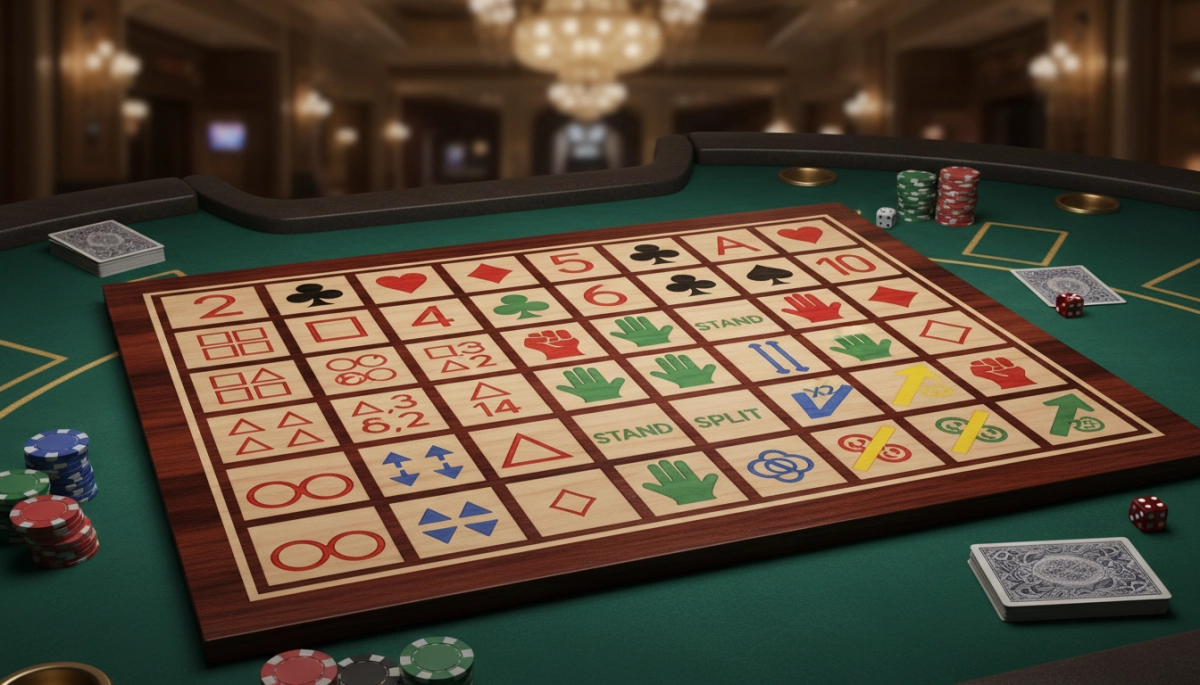
Why a blackjack strategy chart should be in your head (and maybe on the table)
You want to play blackjack with the smallest possible house edge, and a strategy chart is the fastest way to do that. A standard chart condenses millions of simulated hands into a simple grid that tells you the mathematically best play for almost every two-card or common multi-card situation. When you use the chart consistently, you remove guesswork and emotion—so you make decisions that improve your expected return over time.
Using a chart doesn’t guarantee a win on any single hand, but it does shift the odds in your favor relative to poor or instinctive play. As you learn the chart, you’ll react faster at the table and make fewer costly mistakes like standing on a weak hand or splitting the wrong pair.
How to read the chart: dealer upcard vs. your hand
Most strategy charts are organized as a matrix: your hand value on one axis and the dealer’s upcard on the other. Once you find the intersection, the chart will tell you to hit, stand, split, or double down. Familiarize yourself with three common hand categories: hard totals, soft totals, and pairs.
Hard totals, soft totals, and pairs — what they mean for decisions
- Hard totals are hands without an ace counted as 11. Examples: 8, 12, 16. These are straightforward: you risk busting if you hit above 21.
- Soft totals include an ace counted as 11. Examples: A-6 (soft 17), A-8 (soft 19). A soft hand can’t bust with one hit, so you can be more aggressive with doubles or hits.
- Pairs let you split into two hands if the chart advises. Splitting turns one decision into two independent hands and is powerful when the dealer shows a weak upcard.
Key table rules that change chart recommendations
Not every casino uses identical rules, and small rule differences change the optimal play. Pay attention to:
- Whether the dealer hits or stands on soft 17 — charts vary depending on this rule.
- How many decks are in play — single-deck, double-deck, and multi-deck charts differ slightly.
- Whether doubling after split is allowed — this affects split strategy for some pairs.
If you sit at a table with non-standard rules, consult the correct version of the strategy chart or adjust your play accordingly. In many cases the basic chart still serves as a strong baseline, but precise adjustments can trim the house edge further.
Now that you understand how charts are structured and what factors change the recommendations, you’re ready to learn the specific plays — the exact situations where you should hit, stand, split, or double down. In the next section, you’ll see clear, actionable rules tied to common hand-and-dealer combinations and learn simple memory techniques to apply them at the table.
Exactly when to hit or stand: hard- and soft-hand rules
Here are the concrete, dealer-upcard–based rules most charts use. These cover the majority of decisions you’ll face and are safe for standard multi-deck games where the dealer stands on soft 17.
- Hard totals
- Hard 17 and up: always stand.
- Hard 13–16: stand if the dealer shows 2–6; otherwise hit.
- Hard 12: stand vs dealer 4–6; hit vs 2,3 and 7–A.
- Hard 11: double vs any dealer upcard (if doubling isn’t allowed, just hit).
- Hard 10: double vs dealer 2–9; hit vs 10–A.
- Hard 9: double vs dealer 3–6; otherwise hit.
- Hard 8 and below: always hit.
- Soft totals (hands that include an Ace counted as 11)
- Soft 19 (A-8) and soft 20 (A-9): usually stand.
- Soft 18 (A-7): stand vs dealer 2,7,8; double vs 3–6 if allowed; hit vs 9–A.
- Soft 13–17 (A-2 through A-6): look to double vs dealer 4–6 (A-5 and A-4 sometimes double vs 4–6, A-3 and A-2 vs 5–6 depending on decks); otherwise hit.
Splitting and doubling down: when to create or increase hands
Splits and doubles move you from passive to aggressive play; used correctly they trim the house edge significantly. These are the standard, widely applicable pair rules:
- Always split aces and eights. Aces give two strong chances at blackjack; eights turn a losing 16 into potentially winning hands.
- Never split tens or fives. Tens are already a strong 20; fives are better played as a 10 (double when appropriate).
- Split twos and threes vs dealer 2–7 (some charts limit splits to 2–6 depending on deck count).
- Split fours only against dealer 5–6 and only if doubling after split (DAS) is allowed; otherwise don’t split.
- Split sixes vs dealer 2–6; split sevens vs 2–7; split nines vs 2–6 and 8–9 (stand vs 7, 10, A).
Doubling: you get one extra card after doubling. The most profitable doubles are hard 9–11 and many soft hands against weak dealer cards (see soft rules above). Important: game rules like “dealer hits soft 17” or whether DAS is allowed change a few of these recommendations — use the chart that matches the table rules.
Simple memory aids and a quick practice routine
Don’t try to memorize an entire grid at once. Use a few compact rules as anchors:
- “17+ stand.”
- “13–16 stand vs 2–6.”
- “12 stands vs 4–6.”
- “Always split A and 8; never split 10 or 5.”
Practice: drill with a flashcard app (10–15 minutes daily) or play low-stakes hands online while pausing to check the chart until you build instinct. When you’re uncertain at the table, default to these anchors — they reduce costly mistakes and buy you time to recall the finer rules.
Before you head to the tables, a couple of final points: consider learning the surrender rules where available (late surrender can change some borderline decisions), avoid tempting side bets that inflate the house edge, and keep your bet sizing disciplined—strategy charts improve decision quality but don’t eliminate variance. If you’re curious about deeper rule-specific charts or want printable versions for practice, reputable resources and simulators can help you match the right chart to the game you’ll play.
Putting the chart to work
Make the chart your default decision engine: practice with low stakes or play simulated hands until the core rules become automatic. On the floor, scan the table rules first (dealer hits/stands on soft 17, decks, DAS) and pick the chart that fits. Stick to the chart under pressure—avoid “feels like” plays—and treat splits and doubles as your tools to convert marginal hands into long-term edge reductions. For detailed charts and rule-by-rule comparisons, see Wizard of Odds blackjack strategy.
Frequently Asked Questions
Will following a basic strategy chart guarantee I win?
No. A strategy chart reduces the house edge and improves your expected return over many hands, but it cannot guarantee wins on individual hands because blackjack has inherent variance. The chart optimizes long-term results, not short-term outcomes.
How do rule variations (like dealer hits soft 17 or number of decks) change the chart?
Small rule changes alter the optimal play for a few specific situations. For example, dealer hitting soft 17 slightly favors the house and can shift some doubling or standing decisions; fewer decks generally favor the player and change split/double thresholds. Always use the chart that matches the table rules you’re playing.
Should I ever deviate from the chart if I feel the dealer is “hot” or after a losing streak?
No. Deviating from basic strategy based on short-term outcomes or perceived streaks increases expected losses. The correct approach is to follow the chart, manage your bankroll, and make adjustments only for verifiable rule differences or if you’re using an established advanced technique like card counting.