
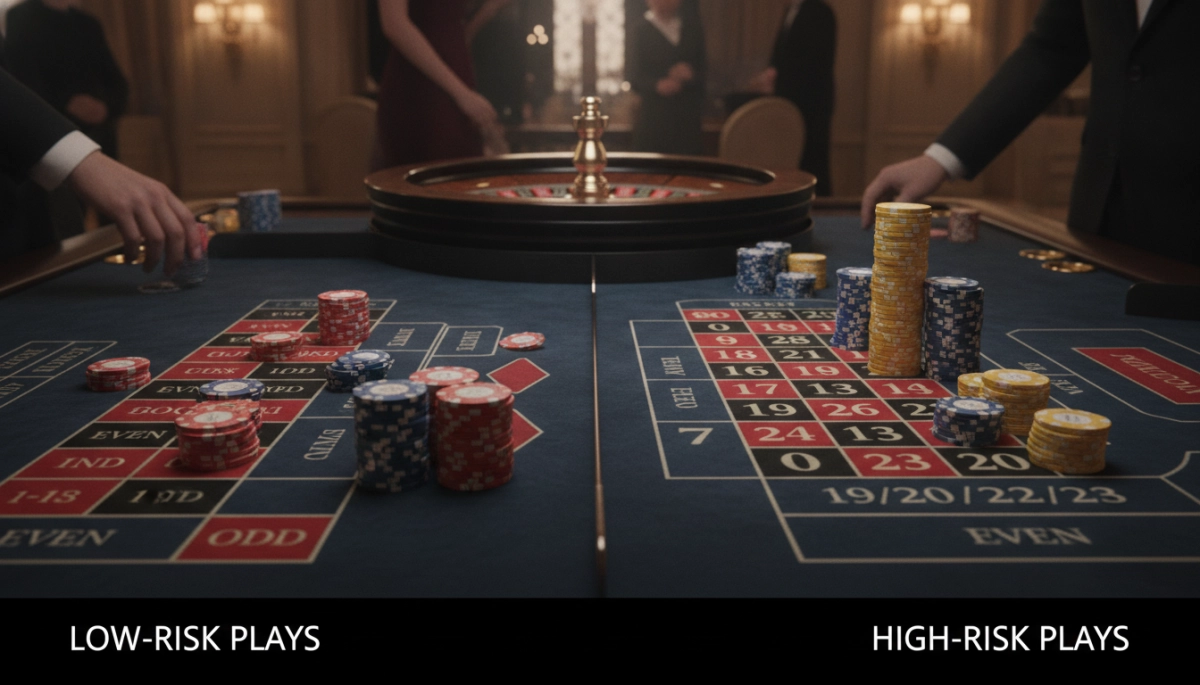
How to frame your roulette decisions before you place a chip
You can treat roulette as a short burst of entertainment or a discipline-driven game of probabilities — your approach should match that intent. Before you place your first bet, decide whether you want steady, smaller wins (low-risk) or the chance of a larger payout at the cost of higher variance (high-risk). Understanding the difference will help you manage your bankroll, control session length, and keep expectations realistic.
Key ideas to keep in mind:
- House edge is fixed: No matter your bet, the casino maintains a statistical advantage. You can minimize variance but not eliminate the edge.
- Volatility affects your experience: Low-risk bets produce more frequent, smaller payouts; high-risk bets produce infrequent, larger payouts.
- Bankroll dictates viable choices: Your stake size and desired session length determine which tactics are practical for you.
How house edge and volatility shape which plays you should use
You should first understand the two structural drivers that change how bets feel at the table: the house edge and payout variance. European wheels (single zero) typically offer about a 2.7% house edge, while American wheels (double zero) increase that to about 5.26%. That difference compounds over time, so your choice of wheel matters if you want to preserve your bankroll.
Volatility — often called variance — describes how much your balance will swing. Even-money bets (red/black, odd/even, high/low) have low volatility and nearly 50% win probability, producing steadier short-term results. Inside bets (single numbers, splits) have much lower hit frequency but pay out at higher multiples, making them high-volatility plays.
- Low volatility: Even-money bets, dozens/columns to a lesser extent.
- High volatility: Straight-up numbers, small combinations, single-number coverages.
- Practical takeaway: If you want to play longer and avoid big drawdowns, favor low-volatility plays and smaller stake units.
Low-risk roulette plays you can apply right away
If your aim is steady entertainment and minimizing the chance of big losses, focus on bets that balance payout and hit frequency. You can reliably stretch a bankroll and keep more of your time at the table by using small, consistent wagers and simple coverage strategies.
- Even-money bets: Red/black, odd/even, high/low. These give you near 50/50 outcomes and are the backbone of conservative play.
- Dozens and columns: Offer ~1 in 3 hit probability with a 2:1 payout, useful when you want slightly better returns than even-money without huge variance.
- Flat betting: Use the same unit size each spin to control variance and avoid chasing losses with bigger stakes.
- Small bankroll percentages: Risk 1–2% of your session bankroll per spin to reduce the chance of ruin and to smooth bankroll swings.
These tactics give you a practical, lower-risk foundation for play; next, you’ll learn how higher-risk plays function, when they might be appropriate, and how to size them responsibly.
When aggressive plays make sense — and when they don’t
High-risk plays are not inherently “bad”; they serve specific purposes. Use them when your priority is a short, exciting session or when you’ve deliberately set aside money you can afford to lose. They are appropriate for players who value variance as part of the experience — chasing the single big hit — rather than steady preservation of capital.
- Reasonable scenarios for high-risk bets: You have a dedicated speculative portion of your bankroll, you’re playing briefly for entertainment, you’ve been funded by a promo or comp, or you’re only willing to risk a small, predefined amount for a chance at a big payout.
- When to avoid them: If you need to protect a core bankroll for long sessions, are trying to meet a time-constrained win target for practical reasons, or are emotionally vulnerable to chasing losses, high-risk plays will accelerate ruin.
- Choose the right wheel: If you’re taking big shots, prefer a single-zero European wheel where available — the lower house edge reduces the speed at which the speculative sleeve evaporates.
Treat aggressive betting as an entertainment line item, not an investment. Because roulette has a negative expected value, mathematically optimal stake sizing for wealth growth (Kelly) would be zero; any positive stake is a choice to accept expected loss for the chance of variance-driven reward. Make that choice intentionally and limit its scope.
High-risk strategies and how to size them responsibly
High-risk options include straight-up bets (single numbers), small combination plays (splits, corners), and concentrated coverage of a few numbers. These yield large payouts but low hit frequency. You can use tactical measures to make them less destructive while preserving the upside.
- Allocate a speculative sleeve: Set aside a fixed percentage of your session bankroll (common practice: 5–15%) for high-risk plays. This isolates losses from your core play funds.
- Limit per-spin exposure: Within that sleeve, size bets to a small portion — e.g., 0.5–2% of your total session bankroll per straight-up shot. This keeps a run of bad luck survivable and preserves the chance to take multiple shots.
- Use stop rules: Predefine both a loss limit (e.g., stop if the sleeve loses 50–75%) and a profit target (e.g., pocket the first 100–200% gain). Locking in wins prevents emotional over-betting after a big hit.
- Avoid doubling systems for long shots: Martingale-style progressions are especially dangerous on single-number attempts because table limits and long loss streaks will quickly bankrupt your speculative sleeve.
Concrete example: with a $1,000 session bankroll, you might designate $100 as speculative. Place single-number bets of $5–$15 per spin (0.5–1.5% of the session bankroll). If the $100 sleeve falls to $25, stop — and if it grows to $250–$300, bank the gains and return to conservative play. These rules keep aggressive shots fun without letting them destroy your session.
Mixing low- and high-risk plays within a single session
You don’t have to choose exclusively between conservative and speculative styles. A hybrid plan often gives the best of both worlds: steady play to protect time at the table, punctuated by controlled, high-upside attempts.
- Core-plus-spec: Use the core bankroll (flat even-money or dozens) for session stability while allocating a small, tracked spec fund for occasional single-number attempts when conditions suit you.
- Trigger-based shots: Only use your speculative sleeve after meeting simple triggers — a small run of profits on core bets, or a fixed number of spins elapsed — to avoid emotional, reactionary betting.
- Session discipline: Set a maximum number of speculative attempts per session to prevent escalation, and always revert to flat, low-volatility play after a win to protect gains.
By planning when and how to apply high-risk bets, you control variance without removing the excitement that draws many players to roulette in the first place.
Practical session checklist
- Decide your session bankroll and session length before you sit down.
- Split funds into a core (low-risk) sleeve and a speculative sleeve with fixed percentages.
- Choose a per-spin unit and stick to flat bets for your core play; limit speculative bet size to a small fraction of the total session bankroll.
- Set both a loss limit and a profit target for the session and for the speculative sleeve; stop when either is reached.
- Prefer a single-zero wheel when taking bigger shots to reduce the house edge where possible.
- Avoid stake-doubling progressions on long shots; they expose you to table limits and rapid depletion.
- Log outcomes and emotions—if you notice chasing or frustration, step away and reassess.
Closing notes on playing with intention
Roulette is best approached as intentional entertainment: pick the style that matches why you’re at the table, set simple, enforceable rules, and treat losses as the price of that experience rather than a failure to “beat” the game. Discipline—bankroll boundaries, pre-set stops, and a clear mix of core and speculative play—keeps sessions enjoyable and preserves your options for future play. For a concise, authoritative reference on wheel types, payouts, and odds, see Wizard of Odds: Roulette.