
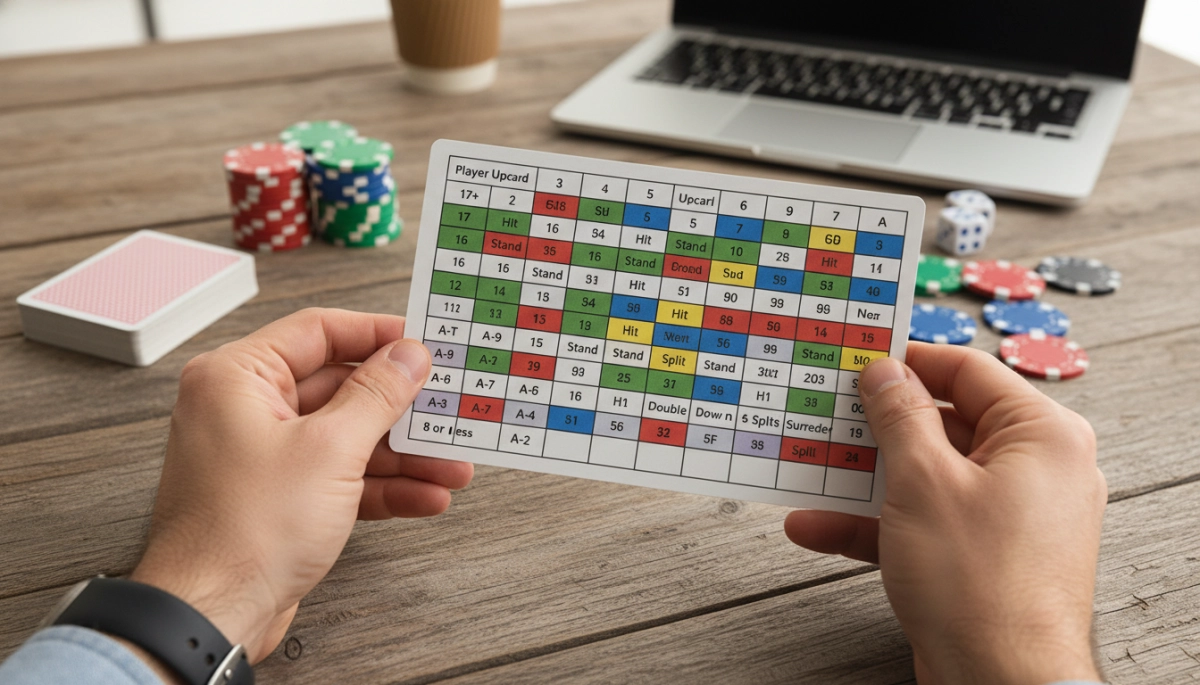
Why a simple strategy chart will change how you play blackjack
You already know blackjack blends skill and luck. A compact strategy chart removes guesswork and gives you a mathematically optimal action for almost every two-card situation. When you use a chart, you make the best play consistently — hitting the dealer’s weak upcards, standing against strong ones, doubling when the odds favor you, and splitting pairs at the right times.
For fast decision-making in live play, the chart becomes your mental shortcut. Instead of pausing to calculate probabilities, you scan the dealer’s upcard and your hand, then follow the recommended action. That speed helps you keep a steady rhythm at the table and reduces costly impulse errors.
- You reduce the house edge by following proven rules.
- Your decisions become faster and less emotionally driven.
- You can focus on bankroll management and table etiquette instead of second-guessing plays.
How to read the chart: hands, dealer upcards, and the four core actions
A basic chart is arranged with your hand types down the left side and the dealer’s upcard across the top. Reading it is a two-step habit: locate your hand row, then find the column for the dealer’s visible card. Each intersecting cell tells you the recommended play.
Know the three hand categories
Charts separate hands into three practical groups. Recognizing which group your hand belongs to is the fastest way to find the correct cell.
- Hard totals: Hands without an ace counted as 11 (for example, 8–16 hard totals). Use these when you have no usable ace.
- Soft totals: Hands that include an ace counted as 11 (for example, A-6 = soft 17). Soft hands give you safer doubling and hitting options.
- Pairs: Two cards of the same rank (for example, 8-8). Pair strategy tells you when to split into two hands.
Four core actions and what they mean
- Hit (H): Take another card. Use this when the chart shows the player’s total is disadvantageous against the dealer’s upcard.
- Stand (S): Keep your current total. Choose this when the risk of busting outweighs the potential benefit of another card.
- Double (D): Double your bet, receive one more card, then stand. Use doubling opportunities on favorable dealer upcards when the chart indicates.
- Split (P or SP): Separate a pair into two hands with an additional equal bet. Splitting is beneficial when each new hand has a better chance of beating the dealer.
Important: chart recommendations assume common rules (e.g., dealer stands on soft 17, doubling after split allowed). Rules variations and number of decks can change a few cells, so treat the chart as rule-sensitive rather than universal. In the next section you’ll get a printable chart layout you can use immediately, plus quick memorization shortcuts for the most frequent situations.
Printable chart layout you can use immediately
Make a one-page chart that’s clean, compact, and easy to scan under pressure. Arrange it as three stacked tables (pairs, soft totals, hard totals) with the dealer’s upcards (2–10, A) as the column headers across the top. Use short codes (H, S, D, P) and a tiny legend at the corner so you don’t have to read long text during play.
Suggested rows to include:
– Pairs: 2–2 through A–A.
– Soft totals: A,2 through A,9 (listed as soft 13–soft 20).
– Hard totals: 5–8, 9–11 (for doubling decisions), 12–16 (stand/hit range), 17+ (always stand).
Practical printing tips:
– One-sided, single sheet in landscape fits most wallets; print on heavy paper and laminate if you plan to take it to casinos (many let laminated strategy cards).
– Use two colors: green for stand/double/split advantages and red for hits to speed visual scanning. If you prefer black-and-white, bold the “stand” and “split” cells.
– Leave a tiny margin or blank row for “table rules” where you jot whether the dealer hits/stands on soft 17, number of decks, and whether doubling after split is allowed—these rules change a handful of cells on the chart.
Below your table add a one-line reminder of the rule assumptions (e.g., “Multi-deck, dealer stands on soft 17, DAS allowed”) so you never use the wrong chart by mistake.
Memorization shortcuts for the most frequent situations
You don’t need to memorize the entire chart at once. Learn a handful of high-value rules that cover most hands you’ll face:
– Always split A-A and 8-8. These are the clearest, highest-impact splits.
– Never split 10s or 5s. Treat 10-10 as a strong 20; treat 5-5 like a ten for doubling decisions.
– Doubling basics (multi-deck, dealer stands on soft 17):
– Double 11 vs dealer 2–10; hit vs Ace.
– Double 10 vs dealer 2–9.
– Double 9 vs dealer 3–6 only.
– Hard totals:
– Stand on 17 and higher.
– For 12–16: stand vs dealer 2–6 (dealer likely to bust), hit vs 7–A.
– With 11 or less, hit unless doubling conditions apply.
– Soft hands (ace counted as 11):
– Hit soft 17 or softer; look for doubling opportunities when dealer shows 3–6.
– Soft 18 (A-7): stand vs 2,7,8; double vs 3–6 if allowed; hit vs 9–A.
These rules cover a large share of common decisions and reduce the number of chart lookups you need during a session. Once you’re comfortable with these, add more specific pair splits (e.g., when to split 3s, 6s, or 9s).
Practice drills to lock the chart into habit
Turn learning into short, focused drills:
– Flashcard rounds: Create 50 flashcards (or use an app). Reveal your hand + dealer upcard and call the chart action within 3–5 seconds. Aim for 90% accuracy before banking real money.
– Timed table runs: Play mock hands with a friend or app and force yourself to decide within three seconds. Speed reduces second-guessing at live tables.
– Zone training: Practice only one area per session—splits one day, doubles the next, hard totals the following. Repetition in focused chunks builds durable memory.
– Progressive concealment: Start with the printable chart visible, then gradually hide it—first a corner, then the whole chart—until you can recall most plays unaided.
– Review your hands: After each casino session, log 20 critical hands where you were uncertain and check the chart. Repetition corrects recurring errors.
Use free online basic strategy trainers and casino apps to get fast feedback. With short, frequent practice sessions you’ll turn the printable chart from a crutch into dependable instinct.
Ready at the table
Bring your printable chart, a clear pre-session plan, and the habit of fast, rule-based decisions. Before you play, confirm the table rules (number of decks, whether the dealer hits or stands on soft 17, and if doubling after split is allowed) and note them on your chart. Keep your sessions short, stick to bankroll limits, and use the chart as a neutral, mathematical guide rather than an emotional thermostat. If you want additional printable layouts and variants for different rule sets, see Wizard of Odds strategy charts.
Frequently Asked Questions
Can I use the printable chart at a casino table?
Yes—most casinos allow small laminated strategy cards or printed charts. Always check the casino’s policy first, keep the chart discreet, and avoid using devices that might disturb other players. Write the table rules on the chart so you’re using the correct version for that game.
How much do rule variations (decks, dealer on soft 17, DAS) change the chart?
Rule variations shift only a handful of cells: number of decks affects some doubling and standing edges; whether the dealer hits or stands on soft 17 can change soft-hand and some hard-total plays; and allowing doubling after split (DAS) influences pair-splitting strategy. That’s why the printable chart should note the assumed rules—use the matching chart for the table you’re at.
How long does it take to internalize the chart enough to play without looking?
With focused practice drills (flashcards, timed runs, zone training), many players reach comfortable, fast recall for the most common situations within a few weeks of short daily practice. Aim for 90%+ accuracy on flashcards and practice deciding within three seconds to build reliable, table-ready instincts.