
Why basic strategy matters for online blackjack
This guide explains what beginners and recreational players need to know to read blackjack basic strategy charts and use them in online blackjack. Readers will learn the objective and core rules of the game, how charts encode optimal plays for hard hands, soft hands, and pairs, and why adapting a chart to specific rule variations (decks, dealer hits/stands on soft 17, double and surrender rules) matters for expected return.
The objective, basic rules, betting and payouts
The player’s objective is simple: beat the dealer’s hand without exceeding 21. Players receive two cards and may hit, stand, double, split pairs, or surrender depending on the game and table rules. Standard betting is a single wager per hand; blackjack (ace + 10-value) typically pays 3:2, though some online tables use 6:5 which sharply worsens returns. Insurance and side bets are optional and carry larger house edges.
House edge, RTP, volatility and common mistakes
Basic strategy minimizes the house edge by choosing the mathematically best action for each player/dealer combination. Theoretical return-to-player (RTP) figures are long-term averages; a correct basic strategy typically reduces house edge to a small fraction of a percent under favorable rules. Volatility is moderate—short sessions can swing widely—and common mistakes include deviating from chart recommendations, misunderstanding soft hands (ace counted as 11), and misapplying split or double rules. Beginners should avoid insurance and stick to the chart unless counting cards or using other advanced techniques.
How to read a basic strategy chart and spot rule-dependent changes
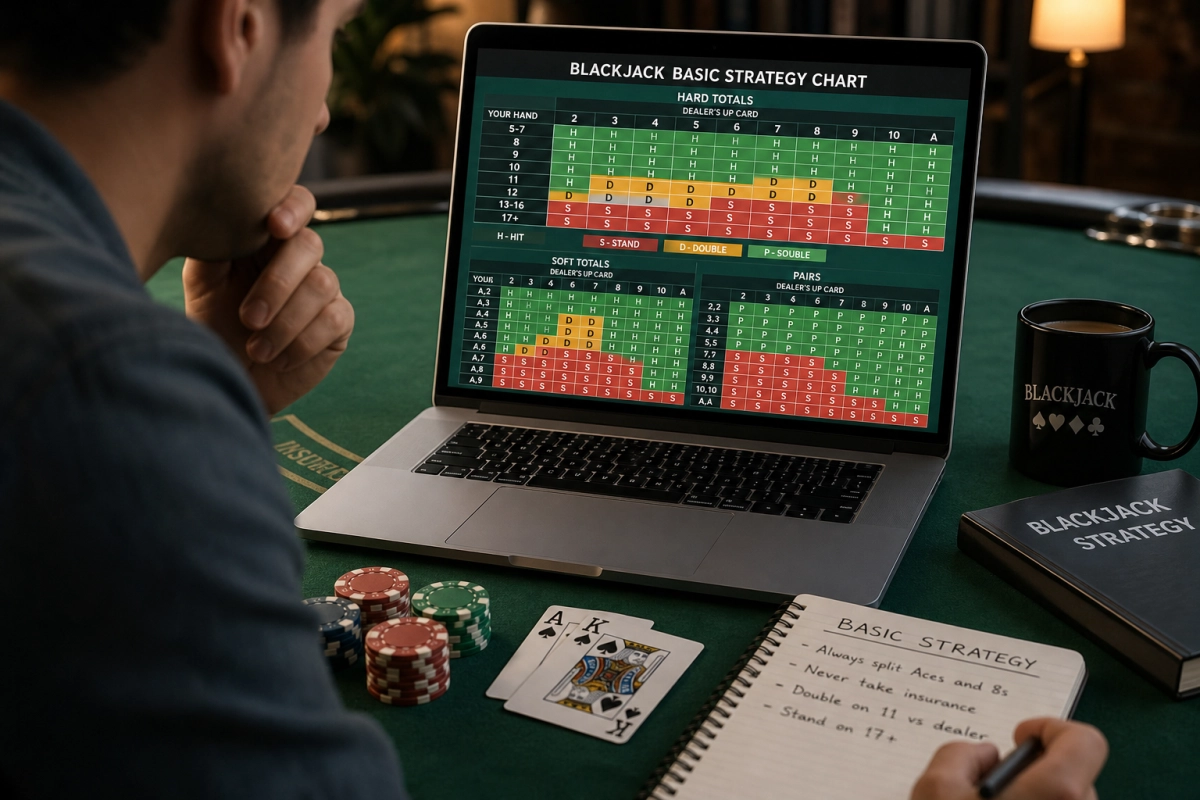
Basic strategy charts are visual grids mapping every possible player hand against each dealer upcard. They usually separate hard totals, soft totals, and pair splits. Each cell contains a recommended action: H (hit), S (stand), D (double), P (split), or R (surrender) — sometimes color-coded for quick reference. To use the chart, find the row for your hand (e.g., “Hard 16”) and the column for the dealer’s upcard (e.g., “10”) and follow the indicated play.
- Hard hands: no ace or ace counted as 1 (e.g., 10–16).
- Soft hands: contain an ace counted as 11 (e.g., A,7 = soft 18).
- Pairs: chart shows when to split (e.g., split 8s against most dealer cards).
Charts vary with rules. Key rule factors that change recommended plays and affect RTP include:
- Number of decks — single-deck, double-deck, and six-deck charts differ slightly.
- Dealer stands (S17) or hits on soft 17 (H17) — H17 usually increases house edge modestly.
- Doubling rules (e.g., double after split allowed or not) — restricting doubles raises the house edge.
- Surrender (late or no surrender) — availability reduces house edge when allowed.
Rule changes typically shift the house edge by tenths of a percent. Exact effects depend on the full rule set and are best estimated by comparing standard chart versions; the next section provides a step-by-step method to adapt charts for common online blackjack rule variations and calculate approximate RTP adjustments.
Step-by-step: adapt a basic strategy chart to your table’s rules
When you open an online blackjack table, treat the rule screen like a checklist. Use this quick procedure to pick or tweak the correct chart before you play:
- Identify the baseline chart you have — note whether it’s for single-, double- or multi-deck and whether it assumes the dealer stands on soft 17 (S17) or hits (H17). Charts are usually labeled (e.g., “6-deck S17, DAS, Late Surrender”).
- Check the table rules — confirm number of decks, dealer S17/H17, whether double after split (DAS) is allowed, whether surrender is offered (late or none), and the blackjack payout (3:2 vs 6:5). Also look for unusual restrictions (e.g., no double on certain totals).
- Match rule differences to chart changes — if the table exactly matches your chart, you’re done. If not, apply small, specific adjustments: use a chart for the correct number of decks and S17/H17; if surrender or DAS is missing but your chart assumes them, adjust decisions that depend on those options (see examples below).
- Triage the biggest decision changes first — some rule differences change only a few cells (e.g., H17 vs S17 slightly alters soft hand doubles and some late-surrender choices), while others (like 6:5 blackjack) fundamentally change whether you should play the game at all. Prioritize matching charts for blackjack payout, deck count, and H17/S17.
- When you can’t find an exact chart, use conservative play: avoid doubling or splitting when the table forbids it compared to your chart; where surrender is unavailable, follow the “no surrender” chart. If in doubt, default to the chart for the more common multi-deck S17 rules (it’s the safest general substitute).
Practical examples:
- If your chart is for DAS but the table forbids doubling after split, do not split hands whose profitability relies on re-doubling (e.g., splitting 2s and 3s against dealer 4–6 becomes less attractive).
- If the table is H17 but your chart assumes S17, switch to a chart that reflects H17. If none is available, be slightly more conservative on soft hands — you’ll want to double less aggressively on soft totals facing certain dealer upcards.
- If a table offers 6:5 blackjack, don’t bother adapting the chart: the payout penalty typically raises house edge so much that correct strategy only limits losses rather than preserving positive expectation.
Estimating RTP/house-edge effects and applying strategy in real play
You don’t need a simulator to get a useful estimate of how rules change RTP. Start from a known reference chart (many published charts list the corresponding theoretical house edge). Then adjust using typical rule impacts to get a ballpark RTP:
- Dealer H17 vs S17: typically increases house edge by a modest amount (often in the low tenths of a percent).
- Removing DAS: noticeably raises edge for hands that benefit from re-doubling (small tenths of a percent).
- No surrender: increases edge by a small amount compared with late surrender allowed.
- Changing deck count: moving from single- to multi-deck slowly increases edge; the effect accumulates across multiple decks but is generally smaller than the H17 or payout changes.
Example calculation (illustrative): if a reference chart for a 6-deck S17 DAS game shows a house edge of ~0.5%, converting to H17 might raise it to ~0.6–0.7%, removing DAS could push it toward ~0.8% and switching to 6:5 blackjack would add several percent and usually makes the game unprofitable. Use these ranges to decide whether to play or look for a better table.
Applying strategy while playing (real-money, mobile, live dealer): keep a chart handy on a second device or in a small printed card (many sites permit this). For mobile apps, open the rules/chart before the buy-in and practice the most frequent decisions until they become automatic: basic stands/hits on hard 12–16 vs dealer 2–6, always split Aces and 8s, double 11 vs dealer upcards except Ace. In live-dealer games, be discreet but quick — decisions are timed; many players use a compact, memorized “top-ten” list of common plays and consult their chart for rare or complex positions. Above all, verify table rules before each session and always use the chart variant that matches those rules to minimize the house edge.
Quick in-play checklist
- Before betting: confirm blackjack payout and the table rule set (decks, S17/H17, DAS, surrender).
- Use the matching basic strategy chart or a conservative multi-deck S17 chart if unsure.
- Memorize the most frequent plays (stand on stiff vs dealer 2–6, always split Aces and 8s, double 11 in most spots).
- If a rule prohibits an action on your chart (no DAS, no double on certain totals), choose the alternative recommended by the “no‑option” chart or stand/hit conservatively.
- Avoid insurance and side bets unless you know the math behind them; they generally favor the house.
- Use a small printed card or a second device for reference when playing mobile or live dealer; practice decisions in free play to reduce decision time under real‑money pressure.
- Manage bankroll and bet sizing: basic strategy minimizes house edge but does not eliminate variance—set session limits and stick to them.
Putting the approach into play
Ready hands and a steady mindset matter as much as the chart. Basic strategy is a tool that gives you the best mathematical footing at the table, but it works best when paired with careful table selection, consistent bankroll management, and disciplined play. Keep learning by practicing in low‑stakes or demo games, check the rules before every session, and make small adjustments only when you clearly understand how a rule change affects expected return. With patience and simple routines, you’ll make better decisions more automatically and get more enjoyment and value from your online blackjack sessions.