
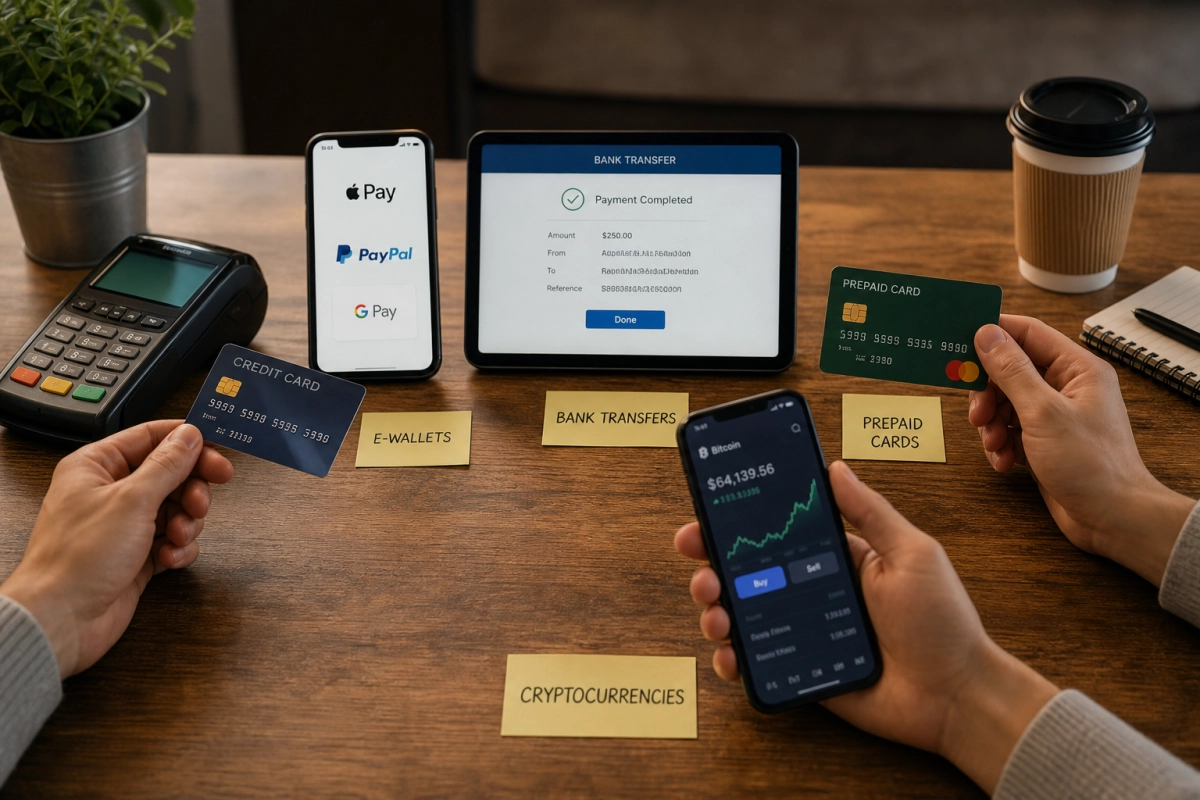
How payment choices shape the online casino experience
Choosing the right payment method influences how quickly players can deposit and withdraw, how much they pay in fees, what verification is required, and whether bonuses apply. This guide explains what readers will learn: a practical breakdown of popular asino payment methods — cards, e-wallets, bank transfers, prepaid cards and cryptocurrencies — and how each performs on withdrawal speed, typical fees, verification/security, bonus compatibility, transaction limits, mobile support and everyday use cases.
The aim is to help both beginners and experienced players match their priorities (speed, convenience, privacy, low cost) to the payment options most likely to deliver those benefits. The next section summarises each method with concise, comparable details so readers can scan and decide what to read in depth later.
Common asino payment methods at a glance
This section gives a short, practical profile of each payment type. Each profile highlights the attributes players most often care about when using an online casino.
Cards (debit and credit)
Cards are the most widely accepted deposit option at online casinos. They are familiar and easy to use but vary in how casinos handle withdrawals and fees.
- Withdrawal speed: Often 1–5 business days for bank transfers via card; some casinos use card refunds which can take several days.
- Fees: Usually none from the casino, but card issuers or banks may charge cash-advance-style fees or foreign-transaction fees.
- Verification/security: Standard KYC checks; 3D Secure and bank verification common.
- Bonus compatibility: Commonly accepted for bonuses, but some promotions exclude credit card deposits.
- Transaction limits: Medium to high; good for larger deposits and withdrawals.
- Mobile support: Strong — integrated into casino apps and mobile sites.
- Typical use case: Players who value broad acceptance and convenience.
E-wallets (PayPal, Skrill, Neteller and similar)
E-wallets act as a fast intermediary between bank/card and casino accounts. They are prized for speed and privacy but sometimes face restrictions depending on jurisdiction and operator rules.
- Withdrawal speed: Often instant to 24 hours when withdrawing to the e-wallet; bank transfer from the wallet can take longer.
- Fees: Varies — some wallets charge inbound/outbound fees or currency conversion fees.
- Verification/security: Strong — wallet providers perform KYC and offer two-factor authentication.
- Bonus compatibility: Widely accepted, but specific promos may exclude certain wallet deposits.
- Transaction limits: Typically flexible; can support both small and large transfers.
- Mobile support: Very good — dedicated apps and one-tap payments.
- Typical use case: Players who prioritise fast withdrawals and separation between bank and casino accounts.
Bank transfers and instant bank pay
Direct bank transfers and newer instant-bank options are reliable and regulated. They are preferred for large, traceable transactions but may be slower for withdrawals.
- Withdrawal speed: Bank transfers can take 1–7 business days; instant bank pay options may be faster for deposits only.
- Fees: Low or none from the casino; banks may charge fees for cross-border transfers.
- Verification/security: High — full bank-level verification and KYC.
- Bonus compatibility: Usually accepted for bonuses, though terms vary.
- Transaction limits: High limits suitable for big players.
- Mobile support: Increasingly available through banking apps and open-banking integrations.
- Typical use case: Players making large, traceable deposits and withdrawals who accept slower payout times.
These snapshots help narrow choices. The next section will compare each method head‑to‑head for withdrawal speed, fees, verification/security, bonus compatibility, transaction limits and mobile support, using practical examples and tips for selecting the best asino payment methods for different player profiles.
Prepaid cards and cryptocurrencies — profiles and practical notes
Two less conventional — but increasingly important — options are prepaid cards (including virtual one‑time cards) and cryptocurrencies. Each answers different player priorities: prepaid cards for simple budget control and minimal bank exposure; crypto for speed, cross‑border convenience and greater privacy (when allowed).
- Prepaid cards
- Withdrawal speed: Usually not supported for payouts — many casinos only accept them for deposits, so withdrawals must use an alternative method.
- Fees: Low on the card issuer side; watch for currency conversion if you top up in a different currency.
- Verification/security: Minimal when buying the card; casinos still require KYC before paying out, which shifts verification to the withdrawal method.
- Bonus compatibility: Frequently excluded from bonus offers or subject to lower bonus eligibility — read promotion terms.
- Transaction limits: Typically low to medium per card; good for strict spending limits.
- Mobile support: Depends on issuer — virtual prepaid cards work well on mobile but physical ones need in‑store top‑ups.
- Typical use case: Players wanting tight bankroll control, temporary cards to avoid linking bank accounts, or those without a traditional bank option.
- Cryptocurrencies (Bitcoin, Ethereum, stablecoins and others)
- Withdrawal speed: Potentially the fastest — on‑chain transfers can clear in minutes to hours; final casino processing time varies.
- Fees: Network (miner) fees apply; casinos may charge their own crypto conversion fees when converting to fiat.
- Verification/security: On‑chain transactions offer pseudonymity, but reputable casinos still perform KYC on significant withdrawals — wallet security is the user’s responsibility.
- Bonus compatibility: Mixed — some crypto casinos offer crypto‑specific bonuses, while fiat casinos may exclude crypto deposits from standard promos.
- Transaction limits: High for major coins, although casinos sometimes cap crypto withdrawals or convert large amounts through exchanges which can introduce delays.
- Mobile support: Strong via wallet apps and integrated QR/payment flows; smooth on mobile sites and apps that accept crypto.
- Typical use case: Players seeking fast cross‑border payments, lower friction for international accounts, or those who prioritise privacy and control over custody of funds.
Head‑to‑head comparison and practical tips for choosing
Below is a straight comparison across the attributes players ask about most, with pragmatic tips for different profiles.
- Withdrawal speed: Crypto and e‑wallets usually lead (minutes–24 hours). Cards and bank transfers are slower (1–7 business days). Prepaid cards often block withdrawals, forcing alternate payout routes. Tip: If you need quick access to winnings, aim for an e‑wallet or crypto option and confirm casino processing times in advance.
- Fees: Bank transfers and prepaid top‑ups are often cheapest; cards may incur issuer fees; e‑wallets and crypto have conversion/network fees. Tip: Compare the casino’s stated fees and your provider’s currency conversion rates — small differences compound on big wins.
- Verification/security: Banks and regulated e‑wallets perform strong KYC; crypto can be anonymous on‑chain but casinos typically require ID for larger withdrawals. Tip: Complete KYC early to avoid payout delays.
- Bonus compatibility: Policies vary — prepaid and some e‑wallets are commonly excluded; crypto may have separate promos. Tip: If chasing bonuses, read the full T&Cs about excluded deposit methods and wagering rules before depositing.
- Transaction limits: High for bank transfers and cards, flexible for wallets and crypto, low for prepaid. Tip: High rollers should check maximum payout caps and whether casinos process large withdrawals via bank transfer or staged payments.
- Mobile support: E‑wallets, cards and crypto wallets are well optimised for mobile; bank interfaces are improving; prepaid depends on issuer. Tip: If you play primarily on mobile, test a small deposit to ensure the flow works smoothly.
In practice, many players combine methods: use a prepaid or card for deposits, an e‑wallet for fast returns, and bank transfers for large payouts. Always verify the casino’s withdrawal hierarchy (most pay back via the original deposit route first) and keep copies of receipts and KYC documents to speed up any hold or review.
Choosing and managing your payment mix: practical next steps
Decide what matters most to you—speed, privacy, low cost or simplicity—and let that guide the combination of payment methods you use. Before staking significant amounts, verify accounts and test the flows with small deposits and withdrawals so there are no surprises. Keep records of receipts and KYC documents, use strong account security, and revisit the casino’s payment terms regularly so you’re always prepared if a payout or promotion needs attention.
Quick action checklist
- Pick a primary method aligned with your top priority (speed, privacy, cost, or convenience).
- Complete KYC for both the casino and your payment provider early to avoid withdrawal delays.
- Do a small test deposit and withdrawal to confirm processing times and any hidden steps.
- Read bonus terms before depositing to ensure your chosen method is eligible.
- Save transaction receipts and KYC copies in case you need to escalate a payout issue.
- Enable two‑factor authentication and secure your wallets/passwords with a manager.
- Recheck fees and currency conversions periodically, especially when using crypto or cross‑border transfers.