
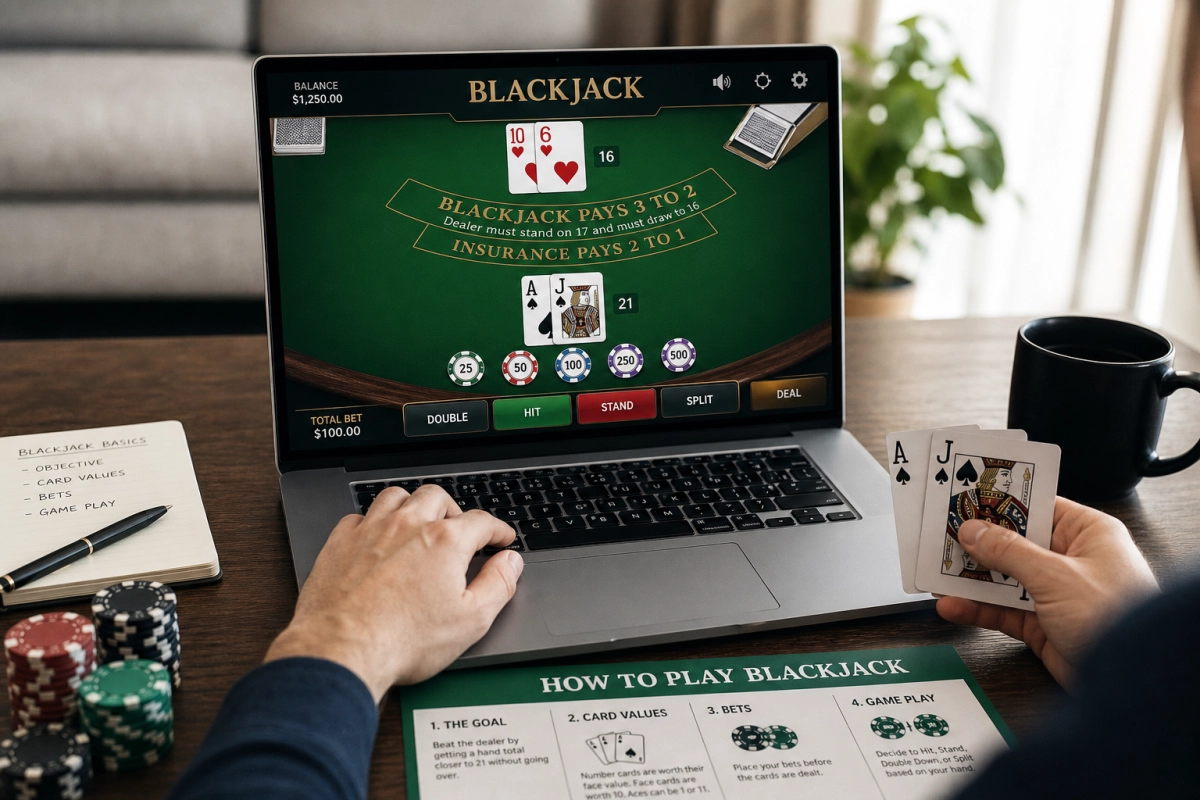
Getting Started with Online Blackjack
Online blackjack is a casino table game in which the player aims to finish with a hand closer to 21 than the dealer’s hand, without going over 21. This beginner’s guide explains the objective, card values, betting choices and round-by-round process before moving on to strategy, table rules, bankroll planning and live dealer formats.
Unlike games based almost entirely on random outcomes, blackjack includes decisions that can affect the mathematical house edge. However, no playing method guarantees a profit. Each hand remains uncertain, and the result of one session does not predict the next.
Blackjack Rules, Card Values and Hand Outcomes
Number cards are worth their printed value, while jacks, queens and kings count as 10. An ace can count as either 1 or 11, depending on which value gives the hand the best total without exceeding 21. For example, an ace and a six usually count as 17, while an ace, six and nine count as 16 because the ace must be valued at 1.
The player and dealer generally receive two cards. The player’s cards are visible, while the dealer normally shows one card and keeps the other hidden until the player has completed their decisions. A two-card hand containing an ace and a 10-value card is called a blackjack. Its payout depends on the table, with 3:2 generally more favourable to the player than 6:5.
Possible results
- Win: The player’s total is higher than the dealer’s without exceeding 21.
- Loss: The player busts, or the dealer finishes with a higher valid total.
- Push: Player and dealer have the same total, so the original stake is returned.
- Blackjack: The player has an ace and a 10-value card in the opening two cards, subject to the game’s payout rules.
How a Typical Online Blackjack Round Works
Before dealing begins, the player selects a table and places a wager within its posted minimum and maximum limits. A careful pre-session check should include the blackjack payout, number of decks, dealer rules and available betting options. Side bets may appear alongside the main wager, but they usually carry a higher house edge and are not required to play the standard game.
- Place the main bet: The player chooses a stake and confirms it before the betting timer closes.
- Receive two cards: The online table displays the player’s hand and the dealer’s visible card.
- Choose an action: Depending on the hand, the player may hit, stand, double down or split.
- Dealer resolution: After the player acts, the dealer reveals the hidden card and follows fixed drawing rules.
- Settle the hand: The platform compares totals and credits any winning return according to the table’s paytable.
Hitting requests another card, while standing ends the player’s turn. Doubling down normally doubles the original wager in exchange for one additional card, and splitting separates matching-value opening cards into two hands. These choices involve different risks, so a beginner should understand the table controls before wagering real money.
Next, the guide will examine dealer drawing rules, common table limits and the basic decisions that help players compare blackjack tables more carefully.
Dealer Rules, Table Limits and Basic Decisions
Unlike the player, the dealer does not choose whether to hit or stand. The table rules determine the dealer’s actions. In many games, the dealer must draw until reaching at least 17, then stand. Some tables require the dealer to stand on all 17s, while others require a hit on a “soft 17”, such as ace, six. Standing on soft 17 is generally more favourable to the player.
Table limits show the smallest and largest permitted main bets. A low-limit table may accept wagers of $1 or $5, while higher-limit games can require substantially larger stakes. The limit itself does not determine the game’s quality, so also check the blackjack payout, dealer soft-17 rule, surrender availability and doubling restrictions. A table offering 3:2 blackjack and reasonable rules may be preferable to one with a very low minimum but a 6:5 payout.
Basic strategy uses the player’s total and the dealer’s visible card to select the mathematically strongest action for the specific rules. As a general introduction, players often stand on strong hard totals, hit weaker totals and consider doubling when one additional card could create a powerful hand. Splitting aces and eights is commonly recommended, while splitting 10-value cards is usually avoided. These are simplified examples rather than a complete strategy chart; the correct decision can change with the number of decks and table rules.
House Edge, Bankroll Planning and Mobile Play
The house edge is the casino’s mathematical advantage over many hands when the game is played under stated rules. Basic strategy can reduce this edge, but it cannot remove variance or guarantee a positive session. Side bets, insurance and tables that pay 6:5 on blackjack commonly increase the casino advantage, so beginners should understand their cost before adding them.
A practical bankroll plan starts with money set aside only for entertainment. Choose a stake that remains affordable if several hands lose in succession, and avoid increasing bets to recover losses. Session limits for both time and spending can make it easier to stop as planned. Never use borrowed money, essential household funds or credit needed for other commitments.
Mobile blackjack can be convenient, but a smaller screen may make rules, paytables and betting controls harder to inspect. Use a secure connection, check that the site is licensed in the relevant jurisdiction and confirm the wager before each round. Avoid playing while distracted, tired or under the influence of alcohol. If gambling stops feeling recreational, use deposit limits, time-outs or self-exclusion tools offered by the operator and seek support from an appropriate gambling-help service.
Live Dealer Blackjack and Responsible Play
Live dealer blackjack uses a streamed table with a human dealer, while bets and decisions are made through the website or app. It can provide a more social format and visible dealing process, but the same rules, house edge and financial risks apply. Check the betting window, seat availability, minimum stake, payout terms and any commission or special rule before joining.
Whether the game is automated or live, treat each round as a separate wager rather than a way to recover earlier losses. Responsible play means setting boundaries in advance, keeping records of deposits and withdrawals, and stopping when those boundaries are reached.
Playing with Clear Expectations
Online blackjack is best approached as entertainment rather than a source of income. Take time to understand the table rules, make decisions within a pre-set budget and accept that even well-informed play can produce losing sessions.
Choose games that suit your experience and spending limits, pause regularly and stop when gambling no longer feels comfortable. A clear plan, realistic expectations and willingness to walk away are more valuable than trying to predict the next hand.