
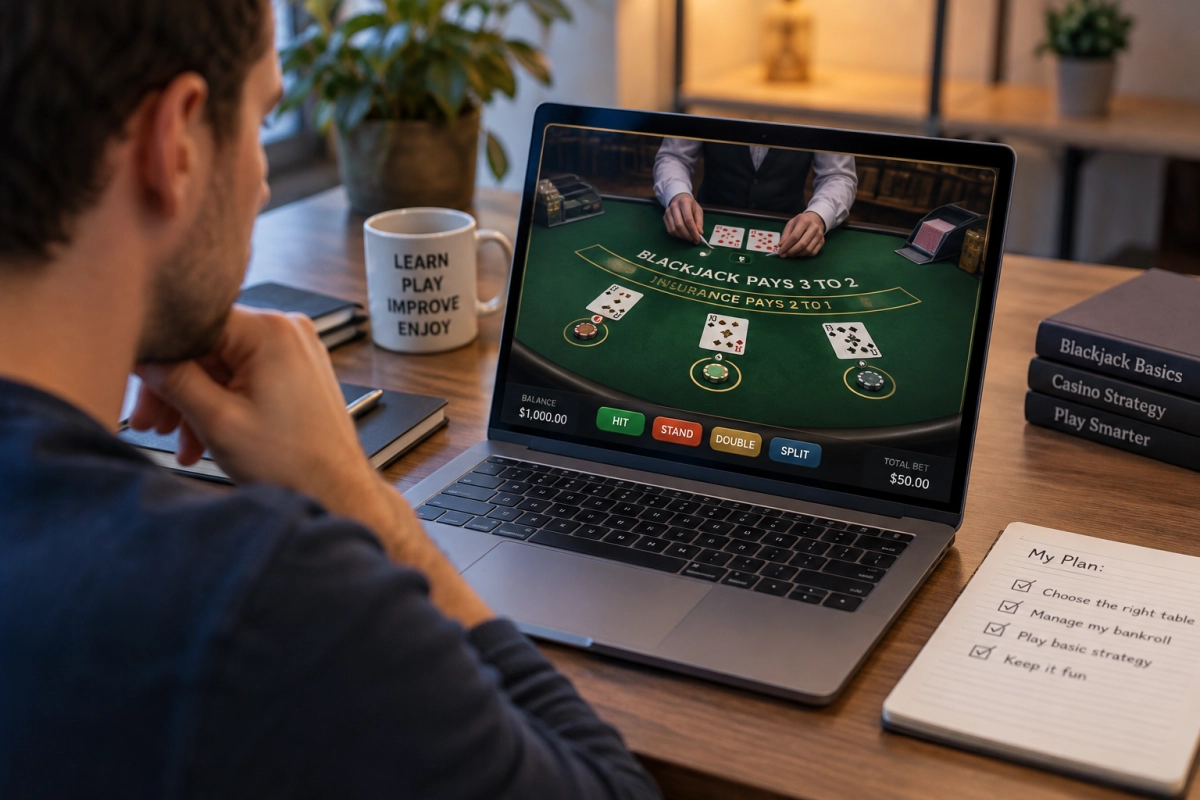
Start with the Rules That Shape Online Blackjack
Choosing online blackjack becomes easier when you understand what separates one table from another. The objective is to build a hand closer to 21 than the dealer’s hand without going over. Number cards retain their face value, face cards count as 10, and an ace counts as either 1 or 11. You can usually hit, stand, double down, or split matching cards, although the exact options depend on the table rules.
Before placing a bet, check the blackjack payout. A natural blackjack traditionally pays 3:2, while some tables pay only 6:5. On a $10 wager, that means $15 at 3:2 compared with $12 at 6:5. The lower payout increases the casino’s mathematical advantage, so tables offering 3:2 are generally preferable when other rules are comparable.
Rules worth checking before you play
Small rule differences can affect the house edge and your available decisions. Look for these details in the game information panel:
- How many decks are used.
- Whether the dealer stands or hits on a soft 17.
- Whether doubling is allowed on any two cards or restricted hands.
- Whether you can double after splitting.
- Whether late surrender is available.
- How blackjack, insurance, and pushes are settled.
Blackjack involves meaningful decisions, but it is still a game of chance. Basic strategy can reduce errors and help you make mathematically appropriate choices for common situations; it cannot predict individual hands or guarantee a positive result.
Compare RNG and Live Dealer Blackjack Tables
Online blackjack is commonly available in two formats. RNG blackjack uses software to generate outcomes and usually offers faster play, a broad range of betting limits, and convenient mobile access. It can suit beginners who want to practise at low stakes or play without waiting for a seat.
Live dealer blackjack uses a streamed table with a human dealer, while software communicates your decisions to the physical game. This format provides a more social casino experience and lets you watch cards being dealt in real time. However, live tables may have slower rounds, limited seats, and higher minimum wagers than RNG games.
Use a practical comparison checklist
Rather than choosing a game only because it looks appealing, compare its rules and practical features:
- Betting range: Confirm the minimum and maximum stake fits your planned bankroll.
- Speed: Choose RNG play for control over pace or live play for a table atmosphere.
- Availability: Check whether the game works reliably on your phone or tablet.
- Transparency: Review the rules, payout schedule, and operator information before depositing.
- Side bets: Treat optional wagers such as Perfect Pairs or 21+3 separately from the main game.
Set Limits Before Using Strategy Tools
A basic strategy chart is useful because it matches your hand and the dealer’s visible card with the statistically preferred action. Keep the chart beside you while learning, but remember that it does not change the randomness of the next hand. Side bets often offer attractive potential payouts but typically carry a higher house edge than the main blackjack wager.
Decide your session budget, maximum loss, and stopping point before you begin. Avoid chasing losses, increasing stakes to recover money, or treating bonuses as extra cash without checking wagering requirements, maximum bets, expiry dates, and withdrawal conditions. Next, we will examine betting limits, bankroll sizing, and the most common mistakes in greater detail.
Match Betting Limits to a Realistic Bankroll
The table minimum should be compatible with the amount you can afford to lose, not simply with the amount you would like to win. A useful starting point is to decide how many minimum bets your session bankroll represents. For example, a $200 bankroll gives you 40 units at a $5 table, but only 10 units at a $20 table. The lower-limit option generally provides more room for normal swings in results.
Keep your main blackjack wager consistent while you are learning. Flat betting one unit per hand makes it easier to track results and prevents a short losing sequence from consuming your funds quickly. A betting system that tells you to increase stakes after losses cannot overcome the house edge or make a random outcome more predictable. If the available minimum is too high for your budget, choose another table or wait rather than stretching your limits.
Separate playing funds from everyday money
Use only money set aside for entertainment, and never use rent, bills, credit, or borrowed funds. You can divide a session budget into smaller portions, such as two or three planned visits, but do not regard the unused portions as permission to continue after reaching your loss limit. Set both a monetary limit and a time limit. Long sessions can encourage automatic decisions, fatigue, and impulsive stake increases.
Use Basic Strategy Without Turning It into a Betting System
Basic strategy works by selecting the action with the best expected outcome for a particular player hand, dealer upcard, and set of table rules. A chart designed for one number of decks or one blackjack payout may not be exact for another game, so use a version that matches the table as closely as possible. If the operator provides an in-game strategy guide, check whether it reflects the current rules.
Practise recognising common situations before playing for money. Hard hands contain no ace, or contain an ace that must count as 1 to avoid going over. Soft hands contain an ace that can still count as 11. Pairs may create a split decision, while doubling commits an additional stake in return for receiving usually one more card. The chart may recommend an action that feels counterintuitive, but individual results do not show whether the decision was correct.
Do not change your decision because the previous hand was a win, loss, or blackjack. Cards are not “due,” and a streak does not make a particular outcome more likely on the next deal. Insurance is also not a general safety measure; it is a separate wager and is usually unattractive unless specific conditions make it mathematically justified.
Recognise Mistakes That Make Sessions More Expensive
Common errors include playing without checking the payout, accepting a 6:5 table when a comparable 3:2 game is available, and assuming a live dealer format is automatically fairer or more favourable. Convenience and presentation do not replace rule checking. Read the game help panel, confirm the settlement terms, and test the interface in free play if that option is available.
Other mistakes happen after the first losing hands. Avoid chasing, drinking while playing, switching between tables without checking their limits, and using side bets to make a quiet session more exciting. Pause when you feel frustrated or start making decisions faster than usual. A clear stop rule, a modest stake, and consistent use of the appropriate strategy chart are more useful than trying to recover losses with one large wager.
Make Deliberate Choices and Keep Blackjack Enjoyable
The best online blackjack experience comes from treating each decision as part of a planned form of entertainment rather than a way to solve financial problems. Take time to understand a table before joining, play only within limits that feel comfortable, and step away whenever the session stops feeling controlled.
There is no need to hurry. A suitable game, a clear plan, and the willingness to stop are more valuable than chasing a bigger win. If gambling no longer feels enjoyable or manageable, pause your play and seek support from a trusted person or an appropriate gambling-help service.