
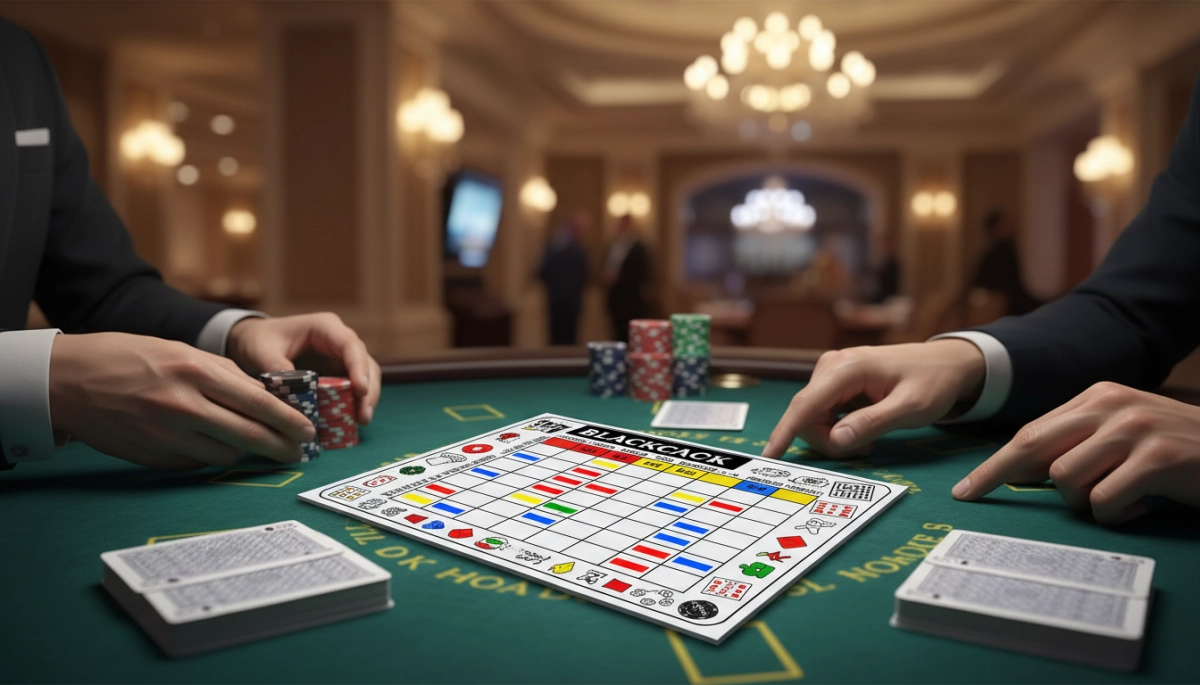
Make smarter hands with a blackjack strategy chart
You can significantly improve your blackjack results simply by using a basic strategy chart and a few quick habits. A strategy chart condenses mathematically optimal plays into an easy visual reference so you no longer guess whether to hit, stand, double, split, or surrender. When you play with the chart’s guidance, you reduce the house edge and remove emotional mistakes that typically cost money.
This part introduces what the chart tells you and how to read it fast at the table. You’ll also get actionable tips that you can start practicing immediately—no advanced math required. Keep in mind that a chart gives the best results when you stick to it consistently and adjust it for the specific table rules you face.
What a blackjack strategy chart actually shows—and why it matters
A typical strategy chart maps your hand on one axis and the dealer’s upcard on the other. Each cell instructs the statistically optimal action for that combination. Understanding those instructions helps you make the lowest-house-edge choice every time, rather than folding to intuition or superstition.
- Hard totals (no ace counted as 11): the chart tells you when to hit, stand, or double.
- Soft totals (hands with an ace usable as 11): these rows show more doubles and fewer hits because the ace reduces bust risk.
- Pairs: the chart shows when to split and when to treat the pair as a single hand.
- Surrender (when available): cells may recommend surrendering to save half your bet on very poor matchups.
Why this is important: by following the chart you remove guesswork and align your play with long-term EV (expected value). The result is fewer costly decisions and steadier outcomes.
Read the chart fast and apply quick, table-friendly habits
Practical steps to use the chart without slowing your game
At the table you need to act quickly and confidently. These tips help you internalize the most common chart decisions and use a physical or mental reference when needed.
- Memorize three to five high-frequency rules first (e.g., always split Aces and 8s; never split 10s; double 11 vs dealer 2–10).
- Practice reading the chart at home with flashcards or a free app so you can scan it in a few seconds.
- Keep a small printed chart in your wallet if the casino allows it; otherwise use a mental shorthand for pairs and soft hands.
- Adjust for rules: fewer decks and dealer-stands-on-soft-17 change a few cells—learn those specific differences.
- Ignore insurance unless you’re counting; the chart generally advises against it.
These habits turn the strategy chart from a reference sheet into a natural part of your decision-making. Next, you’ll learn how to adapt a basic strategy chart to specific house rules and practice drills that build speed and confidence.
Tailor the chart to the house rules you actually face
Not all blackjack tables are created equal. A basic strategy chart is only optimal for the rule set it was calculated for, so the first step is to identify the table rules and then use the matching chart. Key rule differences that change strategy more than others include:
– Dealer hits or stands on soft 17 (H17 vs S17): this slightly shifts some marginal decisions—H17 is worse for the player and nudges a small number of “stand”s to “hit” or vice versa.
– Double rules: whether you can double on any two cards or only on 9–11, and whether doubling after splitting (DAS) is allowed, affects many soft-hand and split decisions.
– Surrender availability: late surrender (after dealer checks) or early surrender (rare) changes how you treat certain poor matchups.
– Number of decks: single- and double-deck games have subtle differences from six- or eight-deck shoes; some splits and doubles change due to deck composition effects.
– Blackjack payoff: 3:2 versus 6:5 drastically affects profitability. If a game pays 6:5, basic strategy adjustments won’t recover the lost EV—consider avoiding those tables.
Practical approach: before you sit, scan the table rules and pull up (or carry) the exact chart that matches them. If you can’t find the perfect chart, prioritize these rule checks: payout, dealer on soft 17, and doubling rules. Make a short mental note of the three differences and consult the appropriate chart variant before committing big bets. If the casino allows, keep a tiny laminated chart for that specific rule set.
Practice drills to build speed, confidence and consistency
Turning the chart into second nature takes targeted practice. Use short, repeatable drills that mirror real table pace and stress. Try these exercises at home or with a free app:
– Drill 1 — Hard totals blitz: set a timer for 60 seconds and answer as many random hard-total vs dealer-upcard combos as possible. Track accuracy and beat your score.
– Drill 2 — Soft-hand flow: practice soft totals separately because the presence of an ace changes the logic. Focus on common soft totals (A,6 to A,9) until you respond instantly.
– Drill 3 — Pair-splitting scenarios: flash cards for pairs—get used to always splitting Aces/8s, never splitting 10s, and the situational splits for 2s, 3s, 6s, 7s.
– Drill 4 — Multi-hand simulation: play two or three hands at once (online free play) to learn how split and double decisions interact when managing multiple shoes.
Other habits that speed play:
– Use a 10-second rule at practice: if you can’t decide in 10 seconds, follow the chart default (usually “hit” for marginal totals).
– Record sessions: reviewing mistakes helps cement the right choices.
– Simulate table pressure by adding small stakes while practicing to make mistakes feel consequential.
Handle exceptions and real-table quirks without panic
Certain on-table situations aren’t on the chart. Know how to react so you don’t freeze:
– Insurance: the chart generally advises against it unless you are counting. Avoid it unless you understand EV implications.
– Dealer peek for blackjack: if the dealer checks and has blackjack, accept the outcome quickly—don’t try to re-evaluate your prior play.
– Continuous shuffling machines (CSMs): counting and some deck-dependent decisions lose value. Stick strictly to the chart or avoid CSM tables if you rely on deck effects.
– Multiple hands: strategy stays the same, but variance increases—consider bet sizing accordingly.
By tailoring your chart to the rules, drilling targeted combos, and having simple protocols for exceptions, you’ll make the chart an automatic part of your game and drastically reduce costly, emotion-driven mistakes.
Final tips for making the chart part of your game
Make the strategy chart a routine, not a crutch: practice short drills, sit only at tables whose rules you understand, and keep bets sized to match the reduced—but still present—variance. Treat the chart as your decision framework: follow it consistently, adapt it for the specific house rules, and avoid one-off “feels” that erode EV. For reliable, rule-specific charts and reference material, see Wizard of Odds blackjack strategy charts.
Frequently Asked Questions
Do I need to memorize the entire strategy chart to play well?
No. Start by memorizing a few high-frequency, high-impact rules (for example, always split Aces and 8s; never split 10s; double 11 vs dealer 2–10). Use drills to internalize soft totals and pair decisions next. Keep a small printed chart if the casino allows, and rely on practiced recognition for common scenarios.
Is it legal to use a strategy chart at the table or bring a printed one?
Most casinos allow basic strategy charts or notes, but house rules vary—some dealers or casinos may ask you not to use electronics or large references at the table. If unsure, ask the pit or check posted rules. Online play poses no restriction. When in doubt, rely on mental shorthand learned in practice.
How much does following a basic strategy chart reduce the house edge?
Using correct basic strategy reduces the house edge substantially compared with novice play—typically bringing it down to roughly 0.5% or lower, depending on table rules. Favorable rules (e.g., 3:2 payout, dealer stands on soft 17, DAS allowed) can lower the edge further; unfavorable rules (such as 6:5 blackjack payoffs) increase the house advantage despite correct strategy.