
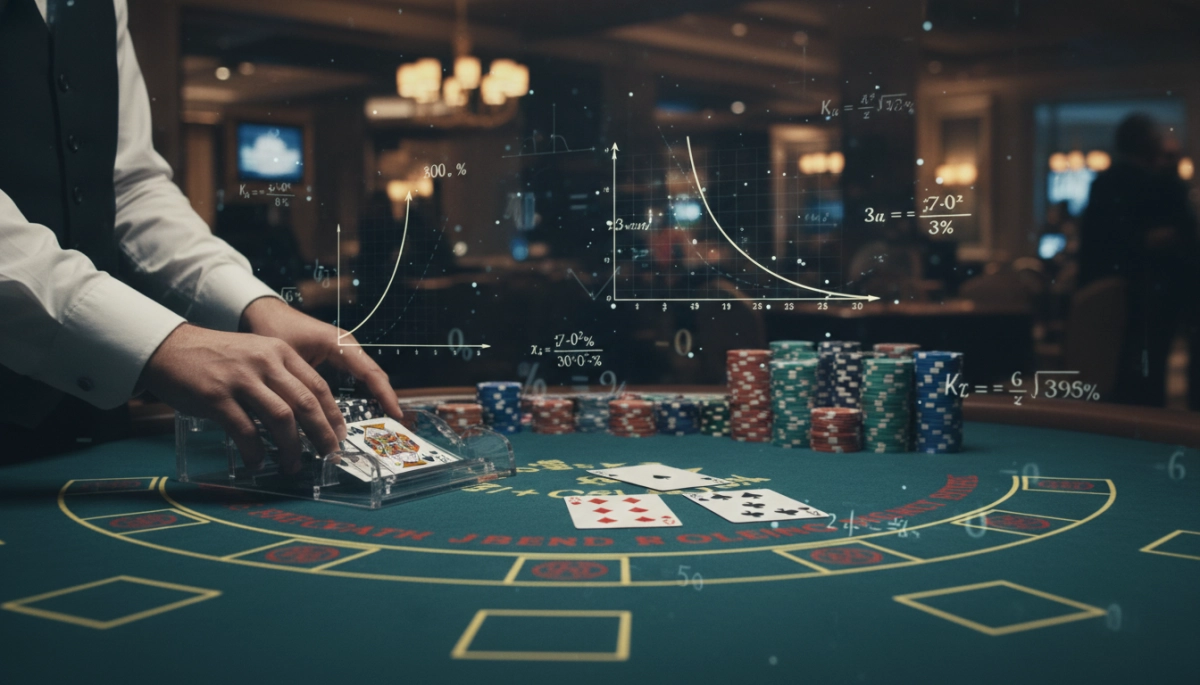
How blackjack odds shape the choices you make at the table
When you sit down to play blackjack, every decision — hit, stand, double, split — is governed by probability. Understanding those probabilities gives you a way to move from guesswork to informed play. You won’t be able to control the cards, but you can control choices that optimize expected value (EV) over many hands. That perspective turns blackjack from pure luck into a game where math and discipline improve your results.
Two central concepts to keep in mind are probability (the chance of a particular outcome on a single hand) and expected value (the average result of a decision over many repetitions). The casino advantage, or house edge, is the difference between optimal player EV and zero — the edge the dealer holds under game rules. With good basic strategy, that edge typically falls to a fraction of a percent; without strategy, it grows substantially.
Essential probability ideas every player should know
- Natural blackjack frequency: In a single-deck game, the chance of being dealt a natural (an ace plus a ten-value card) is about 4.8% — roughly one in 21 hands. That payout (usually 3:2) is a major source of player edge.
- Bust probability: How likely you are to bust depends on your total. For example, hitting on 12 carries a much lower bust risk than hitting on 16; the latter is one reason basic strategy often advises standing on stiff hands in certain dealer-upcard situations.
- Dealer bust rates: The dealer’s chance to bust varies with the upcard. A dealer showing a 6 is far more likely to bust than one showing a 7 or higher. Overall dealer bust probability averages around 28–29% depending on rules and deck count.
- Deck composition matters: The ratio of high cards (10s and aces) to low cards changes probabilities. More ten-value cards increase your chance of naturals and improve doubling outcomes, which is why card counting targets composition shifts.
Simple probabilities that guide basic strategy moves
Basic strategy reduces the complicated decision tree to optimal plays based on your total and the dealer’s upcard. Those rules emerge from comparing probabilities: the likelihood you’ll improve your hand versus the chance of busting, and the dealer’s chance to make a stronger hand. For instance, if the dealer shows a weak upcard (2–6), their higher bust probability justifies standing on lower totals and taking fewer risks.
Some commonly referenced numeric guides you’ll hear at tables and in strategy charts:
- Probability of a natural blackjack: ~4.8% (single deck).
- Average dealer bust rate: ~28–29% (varies by upcard).
- Bust chance for a single hit: rises sharply past totals of 12–13 and becomes very high by 16–17.
These numbers are approximations; exact values shift with deck count and specific table rules. In the next section, you’ll see step-by-step calculations for these probabilities, learn how rules (like 6:5 payouts or multiple decks) shift expected value, and explore how card counting alters the math.
Calculating common probabilities: step‑by‑step examples
To make the ideas above concrete, here are a few simple calculations you can do at the table (or in your head) to see where the numbers come from.
– Natural blackjack (single deck). There are 4 aces and 16 ten‑value cards in a 52‑card deck. The chance to draw an ace then a ten is (4/52) × (16/51); the reverse order is (16/52) × (4/51). Sum them:
2 × (4/52) × (16/51) ≈ 0.0483, or about 4.83% (roughly one in 21 hands).
– Bust probability for one hit (simple approximations). If you have 12, you bust only by drawing a ten‑value card: 16/52 ≈ 30.8%. If you have 13, you bust on a 9 or 10 (4 nines + 16 ten‑values = 20): 20/52 ≈ 38.5%. If you have 16, you bust on any 6–10 (4×4 low ranks + 16 tens = 32): 32/52 ≈ 61.5%. These quick counts illustrate why hitting on 16 is so dangerous while 12 is comparatively safer.
– Doubling on 11. With an 11, you’ll make 21 by drawing a ten about 16/52 ≈ 30.8% of the time; you also gain many favorable two‑card outcomes where a strong single hit beats the dealer. That concentrated upside is the math behind doubling down on 11 in basic strategy.
These calculations are simplified (they treat the deck as unchanged and ignore card removal effects), but they explain the intuition behind basic strategy choices: compare your bust risk and improvement chances with the dealer’s likelihood of making a strong hand.
How rule variations shift expected value at the table
Small rule changes materially change the house edge because they alter those same probabilities.
– Multiple decks. Moving from one deck to six decks slightly lowers the natural blackjack frequency: using the same formula but with 6 decks gives about 4.76% instead of 4.83%. That small change nudges the player’s expected return downward because naturals become marginally rarer and composition effects are diluted.
– Blackjack payout (3:2 vs 6:5). A 3:2 payout (1.5× bet) is standard and generous; a 6:5 payout (1.2×) on a blackjack reduces that premium considerably. Converting from 3:2 to 6:5 typically increases the house edge by roughly one percentage point or more — enough to turn a close game into an unfavorable one for basic strategy players.
– Surrender, double rules, and splits. Options like late surrender (fold for half your bet against terrible dealer upcards), doubling after split (DAS), or re‑splitting aces directly change EV. Allowing DAS and re‑splits gives the player more flexibility and lowers the house edge; surrender trims losses on doomed hands. The net effect of these rules can be measured in tenths of a percent of edge, which matters when you’re playing thousands of hands.
When comparing tables, don’t focus only on betting minimums — look at payouts and rule sets. Small percentage changes add up fast.
A primer on how card counting alters the math
Card counting doesn’t predict the next card; it tracks deck composition to estimate how favorable the remaining shoe is.
– A common system (Hi‑Lo) assigns +1 to 2–6, 0 to 7–9, and −1 to tens and aces. The sum is the running count. Divide the running count by the estimated decks remaining to get the true count.
– The true count roughly correlates with player advantage. A rule‑of‑thumb is that each +1 in true count increases the player’s edge by about 0.5% (so a true count of +4 could swing several percentage points in your favor). That shift comes because higher true counts mean proportionally more ten‑value cards and aces left in the shoe — more naturals, better doubles, and stronger dealer‑bust dynamics.
Counting lets skilled players vary bet size (bet more when the true count is high) and make a few small strategic deviations when the count indicates an altered risk/benefit. It’s not magic — it requires discipline, camouflage, and bankroll management — but it’s the single mathematical method that can turn the small long‑run house edge into a player edge in specific situations.
Putting the math to work at the table
Knowing the probabilities and expected values gives you a practical lens: it’s not about guaranteeing short‑term wins but about making disciplined decisions that maximize your edge (or minimize losses) over time. Focus on mastering basic strategy, choosing favorable rule sets, managing your bankroll, and practicing counting or simulations in low‑risk settings before applying them live. For deeper reference material and calculators you can use to test scenarios, consult the Wizard of Odds blackjack guide.
Frequently Asked Questions
Is card counting illegal?
No — card counting is not illegal in most jurisdictions because it involves no device or outside assistance; it’s merely using your brain to track the composition of the shoe. Casinos, however, reserve the right to refuse service, ask counters to stop playing, or ban them from play. Successful counters practice stealth, bankroll management, and team or bet‑spread discipline.
How much does basic strategy reduce the house edge?
Basic strategy typically cuts the house edge to a fraction of a percent — often around 0.5% to 1% depending on rules and deck count. Deviating from basic strategy or playing on poor‑rule tables (e.g., 6:5 blackjacks, no surrender, no DAS) can substantially increase the edge against you.
Which rule changes should I watch for when choosing a table?
Prioritize blackjack payout (3:2 vs 6:5), dealer stands on soft 17, doubling rules (especially double after split), surrender availability, and re‑splitting aces. Each of these affects expected value by tenths to full percentage points — small numbers that compound quickly over many hands.