
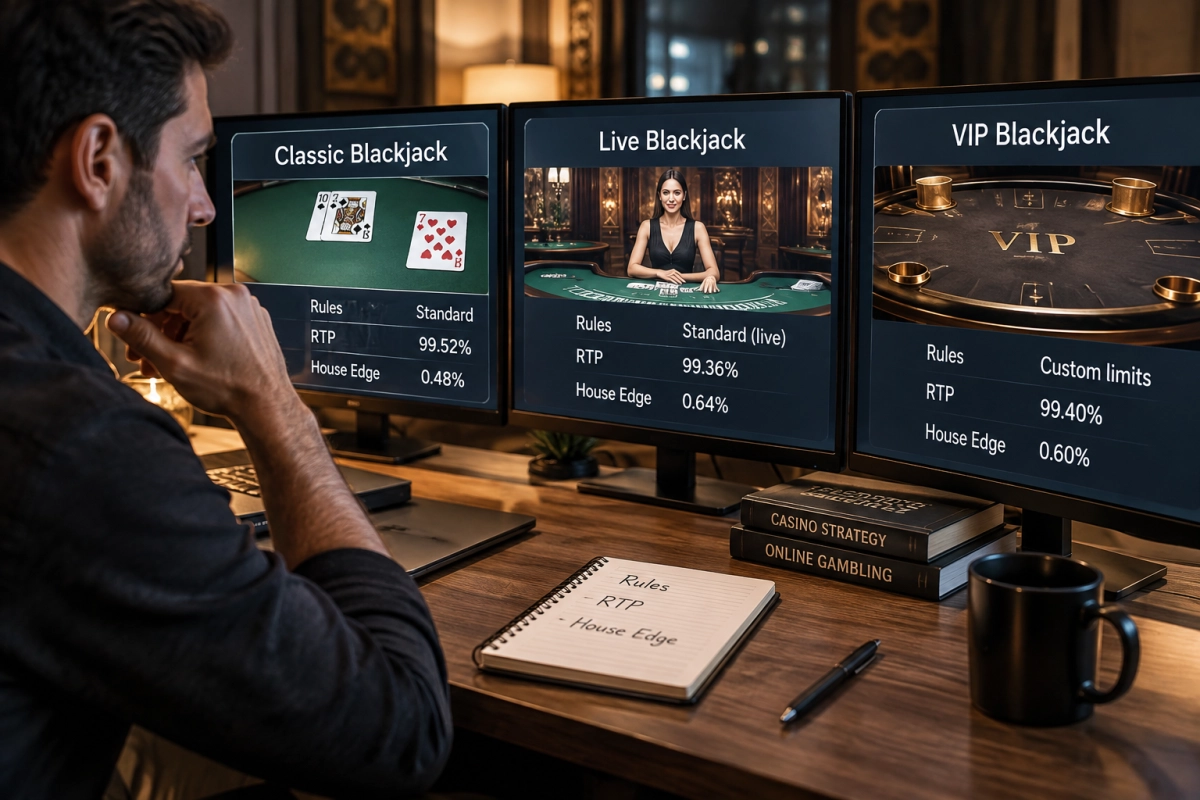
How online blackjack formats differ
Online blackjack uses the same basic objective across most versions: the player aims to reach a hand value closer to 21 than the dealer without going over. Number cards retain their face value, picture cards count as 10, and an ace counts as 1 or 11. Players usually choose to hit, stand, double down or split, while the dealer follows fixed rules.
The main difference between formats is not the objective but the rule set. Dealer actions, the number of decks, blackjack payouts and surrender options can all affect the house edge. A basic strategy chart can help a player make mathematically informed decisions, but it cannot remove the built-in advantage or predict an individual hand.
Classic, European and Atlantic City rules
“Classic” online blackjack generally describes a standard 3:2 game with familiar actions and relatively few unusual features. However, the exact rules are provider-specific, so the table information should always be checked before betting. European blackjack is notable because the dealer often receives only one card initially and checks for blackjack after players complete their hands. If the dealer later has blackjack, doubled or split bets may also lose, increasing the potential cost of an unlucky outcome.
Atlantic City blackjack commonly offers a player-friendly combination of rules: the dealer stands on soft 17, late surrender may be available, doubling after splitting is usually permitted, and a natural blackjack pays 3:2. These features can make the format more attractive than games that pay only 6:5 or restrict doubling and splitting.
| Format or rule | Typical feature | Why it matters |
|---|---|---|
| Classic blackjack | Usually standard 3:2 blackjack payout | Provides a familiar baseline, although other rules still vary |
| European blackjack | Dealer may receive no hole card | Doubled and split wagers can be exposed when the dealer makes blackjack |
| Atlantic City | Often includes late surrender and double after split | Additional player options may reduce the house edge |
| 6:5 blackjack | Reduced payout for a natural blackjack | Usually creates a materially higher house edge than 3:2 |
RTP and house edge in online blackjack
RTP, or return to player, is a theoretical long-term percentage. A game with a 99.5% RTP has a theoretical house edge of 0.5%, assuming the stated rules and correct basic strategy. It does not mean that a player receives 99.5% of a particular deposit or session. Short-term results can be much higher or lower because blackjack outcomes remain variable.
Published figures can differ between games because software providers use different rule combinations. Players should compare the dealer’s soft-17 rule, blackjack payout, surrender availability, deck count and restrictions on doubling or splitting. A 3:2 payout is generally preferable to 6:5, while side bets usually carry a higher house edge than the main wager. The next part examines side bets, live dealer tables, betting limits and mobile availability in more practical detail.
Side bets add variety but usually increase the cost
Side bets are optional wagers placed alongside the main blackjack hand. Common examples include Perfect Pairs, 21+3, Lucky Ladies and insurance. They can produce larger payouts than a standard win, but those payouts reflect much lower probabilities. As a result, the house edge on a side bet is often considerably higher than the edge on the main game, even when the underlying blackjack table has favourable rules.
Perfect Pairs pays when the player’s first two cards form a pair, with higher rewards for coloured or suited pairs. The 21+3 bet uses the player’s cards and the dealer’s visible card to form poker-style combinations such as a flush, straight or three of a kind. The precise return depends on the paytable, so two tables with the same side-bet name may offer different value.
Insurance deserves particular care. It is offered when the dealer shows an ace and pays if the hidden card gives the dealer blackjack. In most standard situations, insurance is not a profitable long-term wager for a basic-strategy player because its price is high compared with its probability of winning. Side bets can be entertaining, but players should treat them as separate high-variance wagers rather than as a way to improve the main game’s odds.
Live dealer blackjack trades speed for a physical table experience
Live dealer blackjack uses a real dealer, physical cards and a streamed table rather than a purely digital game. Players place bets through the casino interface and usually select actions using on-screen controls. The dealer then deals the hand on camera, while a chat window or game display provides the table status and remaining time.
This format can feel more transparent to players who prefer watching cards being dealt, but it is not automatically more favourable. The same factors still determine the house edge: blackjack payout, dealer rules, deck count, surrender terms and the options available after splitting. Some live tables use continuous shuffling machines, while others deal from a shoe and may show additional information about the number of decks. The rules and betting limits should be read before joining.
Live tables also tend to operate at a slower pace than software games. This may suit players who want a more social experience, but it can reduce the number of hands played per hour. Streaming quality, connection stability and the casino’s procedures for interrupted hands are practical considerations too. A reliable operator should explain what happens if a player disconnects after placing a wager or fails to act before the timer expires.
Betting limits and mobile access shape the practical choice
Betting limits vary significantly between formats. Standard online tables often support low minimum stakes and may be suitable for cautious bankroll management, while premium live tables can require substantially larger wagers. A higher maximum bet does not improve the mathematical value of a game; it only gives players the ability to risk more on each hand. Choosing a table whose minimum comfortably fits the intended bankroll is therefore more important than selecting the largest available limit.
Mobile blackjack is widely available through responsive websites and dedicated casino applications. Most modern games work on smartphones and tablets, but the experience can differ by device. Software blackjack generally loads quickly and uses less data, whereas live dealer games require a stable connection and can consume more bandwidth. Before playing on mobile, users should check the screen layout, action-button placement, connection requirements and whether the full rules and paytable are easy to access.
Choosing a Blackjack Format with Confidence
The best blackjack format is the one whose rules, pace and betting limits match the player’s preferences and budget. Before placing a wager, read the table rules carefully, confirm the blackjack payout and review any side-bet paytables. These small checks can make a meaningful difference over time.
Players should also set a spending limit, avoid chasing losses and remember that favourable rules do not guarantee short-term wins. Whether choosing a fast mobile game or a social live table, informed decisions and disciplined bankroll management remain more important than the format’s presentation.