
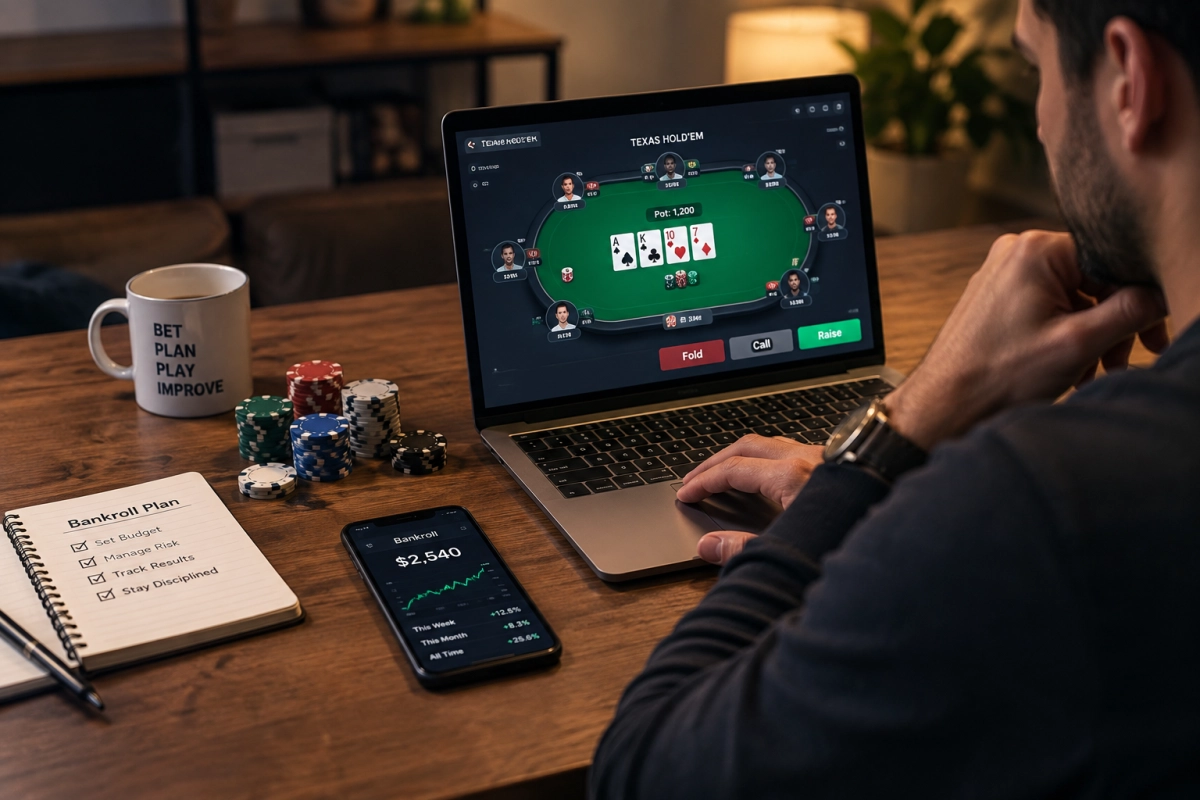
Building a Bankroll for Online Poker
Effective online poker bankroll management helps separate poker funds from everyday finances and gives players clear limits before variance affects decision-making. This guide explains how to size a bankroll, choose suitable stakes, understand buy-ins, and prepare for winning and losing stretches without treating poker as a guaranteed source of income.
A poker bankroll should contain only money that an adult player can afford to lose. It should not include rent, bills, emergency savings, borrowed funds, or money needed for household expenses. A recreational entertainment budget is different from a bankroll: a budget is the maximum amount set aside for enjoyment, while a bankroll is reserved for repeated poker play and may rise or fall with results. If losing the planned amount would create stress or financial difficulty, the appropriate decision is not to play.
How many buy-ins are needed?
A buy-in is the amount used to enter a cash game or tournament. Bankrolls are usually measured in buy-ins rather than only in currency because the same principle can apply at different stakes. Cash games often require fewer buy-ins than tournaments because tournament results can be more uneven, particularly when fields are large.
As a cautious starting framework, a player might consider at least 25 to 30 cash-game buy-ins, with around 40 providing more protection against ordinary downswings. Tournament players may prefer 50 or more buy-ins, while high-variance formats can justify an even larger cushion. These are guidelines rather than guarantees. The suitable figure depends on playing ability, game softness, format, win rate, table selection, and the level of financial risk the player is willing to accept.
| Bankroll | Example cash-game buy-in | Approximate buy-ins | Practical interpretation |
|---|---|---|---|
| $100 | $2 | 50 | Allows a cautious micro-stakes approach |
| $500 | $10 | 50 | May support consistent low-stakes play |
| $1,000 | $20 | 50 | Provides a larger cushion at comparable stakes |
Choosing Stakes and Managing Variance
The correct stake is one that allows a player to make decisions without feeling pressured by every pot. A $100 bankroll, for example, may be better suited to $2 buy-ins than $5 buy-ins. A $500 bankroll could support $10 buy-ins under a conservative plan, while a $1,000 bankroll might support $20 buy-ins. These examples are not fixed recommendations; tournament entry fees, rebuys, game speed, and personal risk tolerance must also be considered.
Variance describes the short-term fluctuation around a player’s underlying results. Even a skilled player can experience a long downswing because strong hands lose, tournament finishes do not arrive regularly, or several close decisions go against them. Bankroll management cannot remove variance, but it can reduce the chance that a temporary downturn ends a player’s poker activity.
Move-up and move-down rules should be written before play begins. A player might move down after falling below a chosen number of buy-ins, and only move up after building a larger reserve above the next stake’s minimum. A separate stop-loss rule can also limit the number of buy-ins lost in one session. The next part will examine stop-loss limits, results tracking, and practical rules for responsible online poker play.
Setting Stop-Loss Limits That Protect Decision-Making
A stop-loss limit sets the maximum amount a player is prepared to lose during one session before leaving the tables. For example, a cash-game player might stop after losing two or three buy-ins, while a tournament player could set a daily limit based on the total entry fees they can afford. The purpose is not to predict when a losing session will end, since losses can continue or reverse at any time. It is to prevent a difficult session from becoming an uncontrolled attempt to recover money.
A useful stop-loss rule should be decided while calm and recorded before play begins. It should include rebuys, add-ons, table changes, and any other entries made during the same playing period. Once the limit is reached, taking a break or ending the session is usually safer than immediately moving to higher stakes. Chasing losses, playing tired, or continuing while frustrated can lead to looser decisions that are unrelated to the quality of the game.
Stop-loss limits should not be confused with a guarantee against harm. A player can lose within the limit repeatedly, and a series of sessions may still create a significant downswing. Reviewing the wider bankroll and following pre-set move-down rules remain essential.
Tracking Results Beyond Wins and Losses
Accurate records show whether poker activity is staying within the intended plan. A simple spreadsheet or tracking application can record the date, game type, stake, number of buy-ins, entry fees, rebuys, cashes, session length, and net result. Tournament players should include every entry and payout, not only final-table finishes. Cash-game players may also record the number of hands, table format, and whether bonuses or fees affected the result.
Results should be reviewed over a meaningful sample rather than judged from one session or one particularly large win. Short-term outcomes are heavily influenced by variance, so a losing week does not automatically prove that a strategy is failing, and a winning week does not prove that a player can safely move up. Reviewing decisions, game selection, and emotional state alongside financial results can reveal patterns such as playing longer when tired or entering stakes that exceed the planned buy-in level.
Records should be kept separate from essential household accounts and checked regularly. If the actual results differ from the plan, the appropriate response may be to reduce stakes, take a break, or reassess whether poker remains affordable.
Keeping Online Poker Within Responsible Limits
Responsible play means treating poker as paid entertainment or a structured hobby, not as a dependable way to pay bills. Players should use deposit limits, session reminders, cooling-off tools, and self-exclusion options where available. It is also sensible to avoid playing while drinking, borrowing money to continue, or hiding losses from people who would reasonably need to know about serious financial pressure.
Warning signs include repeatedly exceeding deposit limits, chasing losses, neglecting work or relationships, feeling unable to stop, and experiencing persistent anxiety about results. If these signs appear, stopping play and seeking confidential support is more important than refining a bankroll formula. A bankroll plan is useful only when the player remains able to follow it.
Making Poker a Sustainable Hobby
A sound bankroll plan creates boundaries before money, variance, or emotion begins influencing decisions. Those boundaries should be realistic, written down, and reviewed whenever a player’s financial circumstances, schedule, or attitude toward the game changes.
There is no requirement to move up, recover a loss, or keep playing through a difficult period. Stepping away, lowering stakes, or ending poker altogether can all be responsible choices. When poker remains affordable, controlled, and enjoyable, bankroll management serves its real purpose: helping the player stay in charge.