
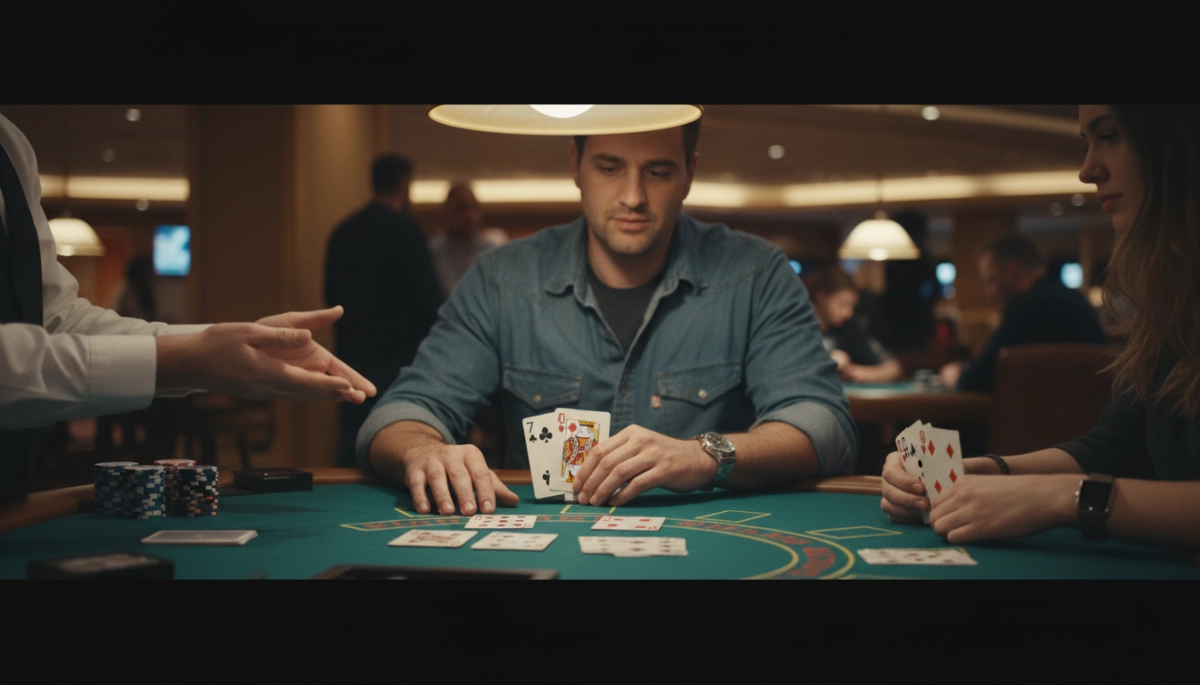
How basic blackjack odds shape the way you play
You don’t need to be a mathematician to use blackjack probabilities to your advantage. By understanding a few core numbers — how often you’ll get a natural blackjack, when the dealer is likely to bust, and how risky a hit is on different totals — you can make clearer, less emotional decisions at the table. These probabilities aren’t magic; they’re predictable outcomes that come from the deck composition and the dealer’s fixed rules.
Key two-card and hand probabilities you should know
Start with the simplest events that matter to you during a deal. These are stable enough that you can build immediate intuition around them.
- Chance of a natural blackjack: In a single-deck game, the probability of being dealt an Ace and a ten-value card in the first two cards is about 4.8% (roughly 1 in 21). In multi-deck games this drops slightly (near 4.7%). A natural pays extra (usually 3:2), which is why it’s an important number to remember.
- Dealer upcard matters: The dealer’s visible card heavily alters outcomes. When the dealer shows a 5 or 6, their chance of busting is highest — that means you’re in a relatively strong position. When they show a 10 or Ace, they are least likely to bust, so you need to be more conservative.
- Risk of busting when you hit: The probability that a single hit will bust you rises quickly as your total increases. For hard totals (no Ace counted as 11): hitting on 12 already carries a noticeable bust risk; by the time you’re at 16, the chance of busting on a single card is substantial. That’s why many rules of thumb tell you to stand on higher hard totals against certain dealer upcards.
What the house edge and rule variations mean for you
The “house edge” is the casino’s statistical advantage over time. With perfect basic strategy, many common blackjack rule-sets reduce the house edge to roughly 0.5% — meaning the casino keeps about 50 cents for every $100 wagered in the long run. However, small rule changes shift that edge noticeably:
- Number of decks: more decks generally increase the house edge a bit.
- Blackjack payout: a 3:2 payout for naturals is much better than 6:5; the latter raises the house edge significantly.
- Dealer actions: a dealer hitting a soft 17 (H17) slightly increases the casino’s advantage compared with standing on soft 17 (S17).
- Doubling and splitting rules: allowing double after split (DAS) and re-splitting aces helps reduce the house edge in your favor.
Knowing these effects helps you pick better tables and manage your bets. In the next section, you’ll see how these probabilities translate into concrete choices — when to hit, stand, double, or split — and how a simple basic strategy uses the odds to improve your results at the casual table.
Translating odds into the four main plays: hit, stand, double, split
Once you understand which events are more or less likely, the next step is using that knowledge to choose between the four main plays: hit, stand, double and split. Basic strategy condenses probabilistic thinking into rules you can follow quickly at the table — here’s the intuition behind the most common lines.
- Hit or stand: Decide based on your bust risk versus the dealer’s chance to improve. If your hard total is in the low-to-mid teens, compare your single-card bust probability to the dealer’s likelihood of busting from their upcard. For example, with a hard 16 against a dealer 10 the odds say the dealer will finish with a stronger hand more often than you will improve, so standing (or surrendering if allowed) is usually the better option. Conversely, with the dealer showing a 5 or 6 — where their bust chances are highest — standing on lower totals like 12–16 becomes sensible.
- Doubling: Doubling is profitable when your expected return from one additional card (plus the extra bet) exceeds the expected return from just hitting normally. Common, reliable doubles for casual players are: double 11 against most dealer upcards (except sometimes an Ace), double 10 against dealer 9 or lower, and double 9 against a dealer 3–6. These plays lean on the fact that you’re more likely to end up with a strong final hand while the dealer is in a vulnerable position.
- Splitting pairs: Splits change the game because you turn one bet into two hands. Always split Aces and 8s: Aces because each can become a strong starting hand, and 8s because 16 is a weak total. Never split 10s (a natural 20 is usually dominant). For other pairs, follow dealer-upcard logic: split 2s, 3s and 6s when the dealer shows a weak card; avoid splitting against strong upcards.
Finally, avoid insurance unless you are counting cards. Insurance is a side bet on whether the dealer’s hole card is a ten-value — the probability is high enough (around three in ten when the dealer shows an Ace) that only card counters with exact deck composition knowledge can make it profitable.
Practical table tactics that use probabilities
For casual players, you don’t need to memorize every percentage—use a few compact habits that reflect the math and keep variance manageable.
- Use a single basic strategy chart: Keep one chart in your head or on a small reference card and stick to it. It translates the odds into crisp plays and removes emotion from split-second decisions.
- Choose rules that help the math: Prefer tables paying 3:2 for blackjack, S17 over H17, and games allowing double after split. These rule choices reduce the house edge, turning the probabilities slightly more in your favor.
- Manage bets, not bets of desperation: Since house edge is low but persistent, set a session bankroll and make modest, consistent wagers. Don’t chase a loss with larger bets unless you’re doing a deliberate, risk-aware progression.
- Avoid side bets: Most side wagers have much worse expected value than the main game; the odds behind them typically favor the house by a large margin.
Applying these straightforward habits converts the abstract numbers into practical decisions you can use the next time you sit at a casual blackjack table.
Putting the odds to work
Use the numbers as a steadying influence: let probabilities guide choices, not emotions. Treat each session as practice in disciplined decision‑making — choose rules that favor the player, keep bets proportional to your bankroll, and accept short‑term swings as part of the game. If you want a deeper, evidence‑based reference for strategy and rule comparisons, see the Wizard of Odds blackjack guide.
Frequently Asked Questions
Can I beat the casino by following basic strategy?
Basic strategy reduces the house edge to a small percentage, improving your chances over naive play, but it doesn’t guarantee a long‑term win. The casino still retains an edge unless you employ advanced methods like card counting (which has its own risks and casino countermeasures).
Is insurance ever a good bet for casual players?
No. Insurance is generally a negative‑expectation side bet for players without precise knowledge of the remaining deck composition. Only card counters who know the deck has a rich proportion of ten‑value cards can make insurance profitable.
How much does the number of decks change the odds?
More decks slightly increase the house edge, but the impact is modest compared with other rule changes (blackjack payout, dealer hitting soft 17, doubling rules). For casual play, prefer tables with favorable payouts and dealer rules rather than focusing solely on deck count.