
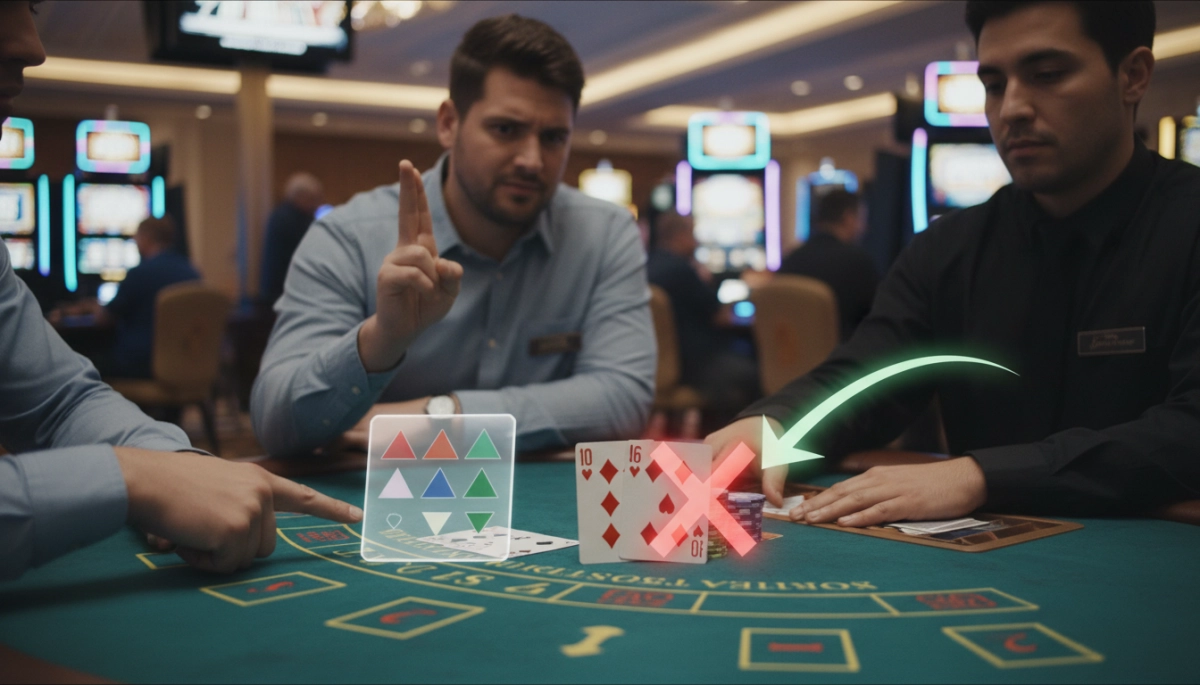
Why learning basic blackjack strategy changes your odds
Blackjack is one of the casino games where skillful decisions materially affect your expected return. When you follow basic strategy — the mathematically optimized set of plays for every two-card player hand against the dealer’s upcard — you minimize the house edge. If you play without a plan, small mistakes compound over many hands and increase losses. This section explains the role of basic strategy and why avoiding common early errors matters for your bankroll and enjoyment.
What basic strategy does for you at the table
Basic strategy prescribes when to hit, stand, double down, split, or surrender based on probability. It doesn’t guarantee wins, but it standardizes your decisions so that luck, not poor choices, mostly determines short-term outcomes. If you consistently apply the correct play, the house edge drops to fractions of a percent in many rule sets — a big difference from ad-hoc play.
Frequent early mistakes new players make and how to avoid them
When you first learn the game, it’s easy to rely on intuition, myths, or emotional reactions. Below are the most common mistakes and practical ways to prevent them.
-
Relying on “feel” instead of the chart
Mistake: You trust a gut feeling like “I usually win if I hit” and ignore the basic strategy chart. Why it hurts: Gut decisions often conflict with the mathematically correct play and raise the house edge. How to avoid it: Keep a small laminated chart in your pocket or use a discreet app when allowed. Practice the chart until the right plays become automatic.
-
Misplaying soft hands and aces
Mistake: Treating a soft hand (one that contains an ace counted as 11) like a hard hand. Why it hurts: Soft hands are flexible; hitting or doubling often has different math than on hard totals. How to avoid it: Memorize soft-hand rules (for example, double against certain dealer upcards) and drill common soft totals in short sessions.
-
Incorrect split and double decisions
Mistake: Splitting tens or failing to split pairs like eights when appropriate. Why it hurts: Splitting or not splitting at the wrong time can switch you from a winning expectation to a losing one. How to avoid it: Learn the pair-splitting table and practice mental cues (e.g., always split Aces and 8s; never split 10s).
-
Letting emotions override strategy
Mistake: Chasing losses by deviating from strategy, or playing conservatively after a string of wins. Why it hurts: Emotional adjustments typically worsen expected value. How to avoid it: Set session limits, use fixed bet sizes, and take breaks after tilt starts to creep in.
These early errors are often easy to fix with a few practice sessions and a commitment to following the chart. In the next section, you’ll get precise examples of wrong table plays, step-by-step corrections, and quick drills to ingrain the right choices at live and online tables.
Concrete wrong plays at the table — examples and step‑by‑step corrections
Seeing the math behind common blunders makes them easier to avoid. Below are several real-table situations where players often go wrong, why the choice hurts expected value, and a short corrective routine you can follow the next time you face the same spot.
-
Hard 16 vs dealer 10 — standing instead of surrendering or hitting
Why it’s wrong: A hard 16 against a dealer 10 is one of the weakest positions in blackjack. Standing gives you almost no chance to improve, while surrender (if allowed) or hitting reduces your expected loss. Correct play: surrender when the rule is available; if not, hit.
Step-by-step correction: (1) Notice you have hard 16 and dealer shows 10. (2) Check rules immediately — can you surrender? If yes, do it. (3) If not, commit to hitting and stop second‑guessing. Saying “surrender if possible, otherwise hit” aloud in practice makes this automatic.
-
12 vs dealer 4 — hitting instead of standing
Why it’s wrong: Many players feel compelled to “take a card” on 12. Against a dealer 4, the dealer has a high chance to bust, so standing is usually correct. Correct play: stand.
Step-by-step correction: (1) Recognize a 12 against 4 as a stand situation. (2) Resist the impulse to improve your hand — remember the dealer’s bust probability. (3) Practice this exact combo until the reflex is to stand.
-
Soft 18 (A,7) vs dealer 9 — standing instead of hitting/doubling when appropriate
Why it’s wrong: Soft totals are flexible; a soft 18 against a 9 is often hit (or doubled in certain rule sets against weaker dealers). Standing reduces opportunities to improve without busting. Correct play: hit (or double when the chart says double).
Step-by-step correction: (1) Identify soft hands by spotting the Ace. (2) Pull up the soft-hand rules in your head (or on a chart). (3) Execute the recommended action immediately.
-
Taking insurance or side bets
Why it’s wrong: Insurance and most side bets have a significantly negative expected value for nonskilled players. Correct play: decline insurance unless you are counting cards and know the deck is rich in tens.
Step-by-step correction: (1) Treat “insurance” as a reflexive no. (2) If interested in side bets, run the payoff math before you play. (3) Keep your bankroll protected by avoiding negative‑EV propositions.
Quick practice drills to make correct plays automatic
Repetition under pressure builds the muscle memory you need to apply basic strategy seamlessly. Use these short, focused drills during practice sessions or before a casino visit.
- Flashcard rounds: Create 30–50 two-card combos on flashcards (or use an app). Time yourself and call out the correct action for each within 3–5 seconds. Track accuracy and target 95%+.
- One‑decision focus: Spend a session practicing only one common trouble spot (e.g., hard 16 vs 10 or soft 18 vs 9). Repeat that scenario until the right play feels immediate.
- Timed table simulations: Use an online trainer that simulates dealer upcards. Play 100 hands at a relaxed stake and review every incorrect decision — note the pattern and drill it afterward.
- Live low‑stakes practice: Visit a low‑limit table or play with friends and enforce a rule: before acting, whisper the chart decision aloud. That verbal cue cements the habit.
- Session checklist: Before each real session, review three things: the rule variations of the table (e.g., surrender allowed? dealer hits soft 17?), one specific hand you’ll focus on, and your fixed bet size.
These drills, combined with the earlier step‑by‑step corrections, shorten the learning curve. In the next part we’ll cover tracking progress, adjusting to different rule sets, and how to scale your practice to higher limits without inviting avoidable mistakes.
Tracking progress, adapting to rules, and scaling your practice
Once you’ve corrected the basic mistakes and practiced the common scenarios, focus on measuring improvement and adapting to table variations. Keep a simple log of sessions: note rule variations (surrender allowed, dealer hits/stands on soft 17, number of decks), common errors made, and any hands that felt uncertain. Review the log weekly and target one recurring mistake with a focused drill.
-
Adjusting to rule sets: Small rule changes shift the optimal plays slightly. If the dealer hits soft 17 or surrender is not available, refresh the specific parts of your chart that change and practice those spots exclusively.
-
Scaling stakes safely: Increase bets only after you consistently reach your accuracy goals in practice (for example, 95%+ correct plays in drills). Raise stakes gradually and keep bet sizing fixed relative to your bankroll to avoid tilt-driven deviations.
-
Continuous feedback loop: Use online trainers that provide immediate feedback, review mistakes after live sessions, and repeat drills on troublesome hands. Periodic self-testing keeps decisions automatic under pressure.
Final steps toward disciplined, low‑error play
Mastering basic blackjack strategy is less about memorizing every rule at once and more about creating reliable habits: consult the chart when unsure, practice troublesome spots until they’re automatic, and protect your bankroll with consistent bet sizing and session limits. Keep learning incrementally and treat every mistake as a data point to fix — not a reason to change your approach. For reliable strategy charts and deeper rule-specific guides, see Wizard of Odds: Blackjack.
Frequently Asked Questions
Should I ever take insurance at the blackjack table?
Generally no. Insurance is a side wager with a negative expected value for players who are not counting cards. Only consider insurance if you have a reliable card-counting advantage indicating a deck rich in tens; otherwise decline it every time.
What’s the fastest way to memorize basic strategy?
Use spaced repetition flashcards or a dedicated app, focus on one decision type at a time (hard totals, soft totals, or pairs), and run timed drills until you reach a high accuracy threshold. Complement digital practice with low‑stakes live sessions where you verbalize the chart decision before acting.
How do I adjust if the table rules differ from the chart I learned?
Immediately note the rule differences (dealer hits/stands on soft 17, surrender availability, number of decks). Look up the strategy variations for those rules and prioritize drills on hands most affected by the change. Keep the rule set written down before you play so you don’t default to the wrong strategy under pressure.